
 Asim Deb
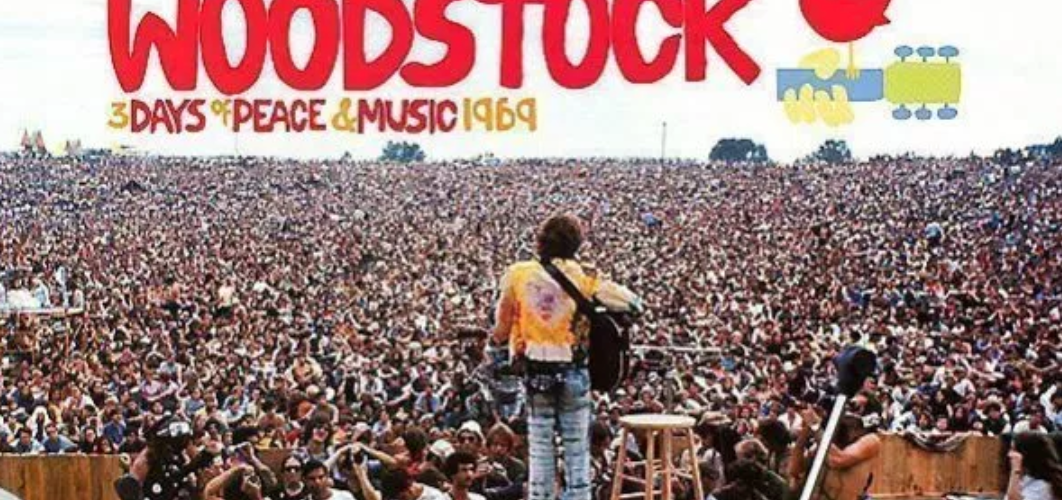
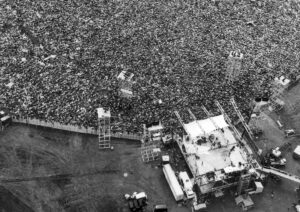
Woodstock 1969: 4,00,000+ Audience In a 3 Day’s Open Air Pop Music Festival.
Compiled by: Asim Deb.
Think of a 3 day’s open air pop music festival in America:
• 4,00,000+ audience against sale of 186,000 advance tickets. Organisers could not resist the rest of the people who were without tickets.
• The western pop music festival was inaugurated by an Indian Yoga Guru.
• Pandit Ravi Shankar in Sitar and Allarakha in Tabla performed in rain in the open air stage.
• Looking at the gathering, Sullivan County declared a state of emergency. Governor of the state and the future Vice President Nelson Rockefeller offered 10,000 National Guard troops to secure law and order.
• Nearby Stewart Air Force Base helped to air-lift performers in and out of the site. And supply food, water and emergency medical helps for 3 days, when the roads became impassable.
• Radio and television discouraged people from setting off to the festival, announcing that the New York State Thruway was closed.
• Helicopter surveillance marshaled local authorities, health care providers and electricity, the US Army, and an eccentric outfit known as Hog Farmers, to avert public health disaster. Team of overworked doctors treated close to 2,500 people in 3 days.
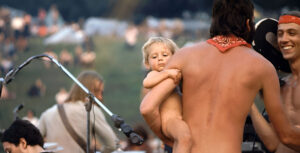
• Two births, one in the car and one in the helicopter.
There were all the reasons and possibilities for a “major human tragedy” but the festival was remarkably peaceful and successful, given the huge crowd and the conditions involved.
Unbelievable, but true.
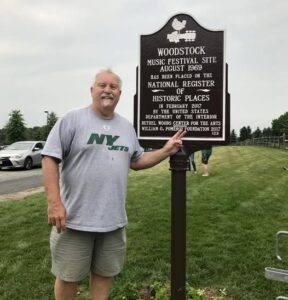
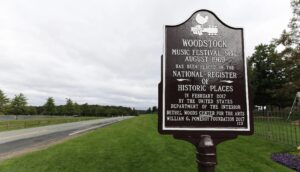
The US Department of Interior now preserves the event site as The National Register of Historic Places. Also, now there is a museum dedicated to the experience and cultural significance of the Woodstock festival. So, originally a dairy firm house, after hosting a musical event, becomes a historic site for music.
********
The time was early days of year 1969.
The whole America was disturbed: politically and socially. Martin Luther King was assassinated in last April 1968. US army was under global criticism for their invasion of Vietnam (only in two specific incidents, the US Army massacred 504 civilian villagers, including women, children and old men in Mỹ Lai village on March 16, 1968 and the Tet Offensive of 30 January, 1968, the most shameful in human history, killing hundreds of civilians by any army on any festival day). Mohammod Ali was criminally convicted with five years in prison, and fined $10,000 for refusing to join the army. And students around the whole country were on the protests against occupying Vietnam.
So, some people, a group of young Americans were searching for their place within it. In that time of conflict and uncertainty, they thought of three days of peace and music, that seemed to be just what a divided nation needed.
Promoters John Roberts, Joel Rosenman, Artie Kornfield and Michael Lang originally envisioned the festival as a way to raise funds to build a recording studio and rock-and-roll retreat near the town of Woodstock, New York. But that needs huge money, huge setup, Organisers had to think for a ground that would accommodate so huge rush; their food, water, healthcare, sanitation, traffic and transport, electricity, rain and mud, law and order, security, drug control, environment protection, resting place, ….. a long list. So, at the end, organisers should ensure “no human tragedies”, specially to care for senior citizen, physically disabled music fans, and the crazy fans who might bring their little child.
Let me first highlight the musical events of the 3 days, August 15 to 18, 1969, and then would come to its preparations:
The plan was big, even if the organisers can make 50% success it would be a remarkable event.
The Indian yoga and religious Guru Sri Swami Satchidananda, inaugurated the show. He was co-founder of the Center for Spiritual Studies in New York with his own brand of Integral Yoga. Swami Satchidananda said in his speech: “Music is a celestial sound and it is the sound that controls the whole universe, not atomic vibrations. Without that war band, that terrific sound, man will not become animal to kill his own brethren. So, that proves that you can break with sound, and if we care, we can make also.”
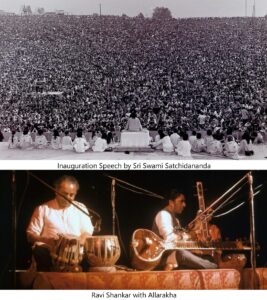
Ravi Shankar, with Allarakha in tabla were for sure someone very special for Woodstock festival. He made his first appearance to the western world at the Monterey International Pop Festival in 1967, followed by an invitation from Beatle George Harrison. During Woodstock, it was raining, and throughout the rain, he started at about 10 pm on Friday evening and played for over 40 minutes.
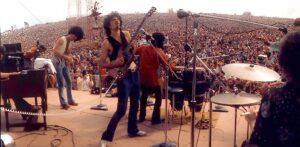
A total of 32 musical acts graced the Woodstock stage. 13 were lead artists with backing bands and 19 were group acts. Altogether, 163 musicians performed on the festival’s main stage! Specially to mention, Santana brought the Latin Rock Fusion to Woodstock. They started at 2:00 pm on Saturday, the 16th. Santana used a huge percussion section at that time and drummer Michael Shrieve added his personal note, especially during the drum solo of “Soul Sacrifice”.
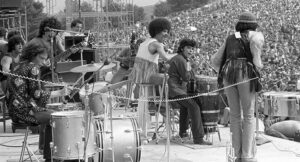
Jimi Hendrix. Hendrix appeared close out the festival on Sunday night. With delays mainly due to rain, Hendrix had two options: play the prime spot on Sunday night but give up being the finale, or wait to close out the show and play to a smaller crowd. Hendrix chose to play last, giving other artists the spotlight while many attendees waited to see him. Hendrix and his new band Gypsy Sun and Rainbows were introduced as the Experience, but he corrected this and added: “You could call us a Band of Gypsies”. They performed a two-hour set, including his psychedelic rendition of the national anthem, which became “part of the sixties Zeitgeist” after it was captured in the Woodstock film.
Missed Connections:
The Beatles were recording Abbey Road at the time and on the verge of breaking up. John Lennon was invited and the Plastic Ono Band, but due to Lennon’s position on Vietnam and 1968 drug bust in England, Richard Nixon and the U.S. government reportedly did not want him in the country.
Simon & Garfunkel could not agree, as they were working on their new album.
Eric Clapton wanted English supergroup Blind Faith to play the festival, but was outvoted by the rest of the group.
Bob Dylan lived in the town of Woodstock but he signed in mid-July to play the 1969 Isle of Wight Festival on August 31.
Led Zeppelin were asked to perform. Their manager Peter Grant stated: “I said no because at Woodstock we’d have just been another band on the bill.”
Planning The Program:
The original plan was for a venue in the town of Woodstock on a site owned by Alexander Tapooz, but local residents objected to the idea. Roberts and Rosenman then again searched for a venue, and discovered the 300-acre (0.47 sq mi; 1.2 km2) Mills Industrial Park in the town of Wallkill, Orange County, New York, which Woodstock Ventures leased for US$10,000 (in current estimation, equivalent around $100,000 today) in the Spring of 1969. Town residents opposed the project. because the Town Board had a law requiring a permit for any gathering of over 5,000 people.
Alarmed at the lack of progress, just 1 month before the scheduled event dates of August 15 to 18, 1969, they could identify a site in Bethel, New York, 60 miles (95 km) southwest of the town of Woodstock on a land belonging to dairy of farmer Mr. Max Yasgur, who received $40,000 for his hospitality. It was a 15-acre (650,000 sq ft; 61,000 m2) motel grounds, and had a permit for events. But Yasgur’s land had a bowl sloping down to Filippini Pond on the land’s north side, and Filippini refused to sign a lease for the use of his property. The organizers again told Bethel authorities that they expected no more than 50,000 people. (that number finally reached 400,000).
Despite opposition from the residents and signs proclaiming, “Buy No Milk. Stop Max’s Hippy Music Festival”, the Bethel Town Attorney Frederick W. V. Schadt, the building inspector Donald Clark and the Town Supervisor Daniel Amatucci approved the festival permits, but the Bethel Town Board refused to issue the permits formally. Organisers challenged that it is unethical to withhold permits which had already been authorized. Finally, Inspector Clark issued the permits. The only pending job: a proceed by the Department of Health and Agriculture.
Change in venue puts the organizers in trouble. The time left was only few days, and construction foremen said to choose between (a) complete the fencing and ticket booths, otherwise the organisers would be facing almost bankruptcy, or (b) trying to complete the stage, as there might be a weekend venue for half a million people. The next morning, overnight, 50,000 “early birds” arrived and settled themselves in front of the half-finished stage. For the rest of the weekend, concert-goers simply walked on to the site with or without tickets. So, a stage in the middle of a small New York farm field ended on the world stage. Another twist, Apollo 11 landed the first man on the moon in July 1969, just a month before the Woodstock Festival. The whole of America’s attention focused on Apollo landing on moon, and marketing of Woodstock took the back seat.
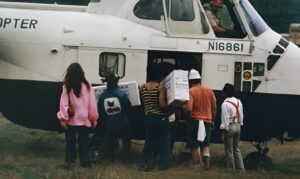
Though Woodstock was conceived as a profit-making venture, but became a “free concert” when circumstances prevented the organizers from installing fences and ticket booths. Tickets for the three-day event cost US$18 in advance and $24 at the gate (equivalent to about $200 and $250 today. Against the estimated plan of 50,000, around 186,000 advance tickets were sold. The influx of people to the rural site in Bethel created a huge traffic jam. The event’s security was to be handled by a group of 346 off-duty New York City police officers, but the officers were forced to withdraw when they were warned that they were violating regulations against moonlighting. On the morning of Sunday, August 17, New York Governor and the future Vice President Nelson Rockefeller called festival organizer John P. Roberts and told him that he was thinking of ordering 10,000 National Guard troops to the festival site but Roberts persuaded him not to. Sullivan County declared a state of emergency. Personnel from nearby Stewart Air Force Base helped to ensure order and air-lifted performers in and out of the site. Radio and television descriptions of the traffic jams discouraged people from setting off to the festival, announcing that the New York State Thruway was closed. In reality, on the other side, helicopters were transporting food and medical supplies when the roads became impassable.
When Woodstock was underway, the neighbours sold water to the masses. Yasgur was unhappy because people should be sensible that water is not an item for money-making enterprise. So, on the side of his farm, he put up a large sign to inform everyone that he had “Free Water.”
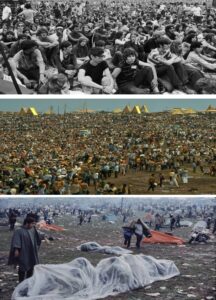
Directors realized they had the potential for one of the “greatest human tragedies in modern times”. Early estimates of attendance increased from 50,000 to around 200,000, but by the time the gates opened on Friday, August 15, about 400,000 people were clamoring to get in. The organizers found no choice but were eventually forced to make the event free of charge. Helicopter surveillance was conducted, and marshaled local authorities, health care providers, local townspeople, the US Army, and an eccentric outfit from New Mexico known as the Hog Farmers, whose extraordinary efforts averted public health disaster. Team of overworked doctors treated close to 2,500 people in 3 days. Two deaths occurred and 3000 first aid visits were recorded.
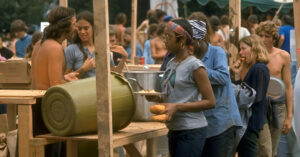
However, the festival was remarkably peaceful given the number of people and the conditions involved, although there were three recorded fatalities: two drug overdoses and another caused when a tractor ran over a 17-year-old sleeping in a nearby hayfield. Births were claimed to have occurred, one in a car caught in traffic and another in hospital after an airlift by helicopter. Miscarriages were reported and over the course of the three days there were 742 drug overdoses. Drug use was a huge part of the festival, with many staying in their tents in the woods and taking LSD in groups. Teens spent time on jungle gyms, while many were guided in yoga exercises. The Voice reported that “in a way, the nudity seemed more natural and necessary than fashionable, since everyone was constantly getting drenched in the rain. By Sunday, the bathers had gotten bolder and petting each other as if it were the most natural thing in the world.”
Max Yasgur, Who Owned the Site:
Max spoke of how nearly 400,000 people in total had spent the 3 days with music and peace on their minds. He stated, “If we join them, we can turn those adversities that are the problems of America today into a hope for a brighter and more peaceful future”.
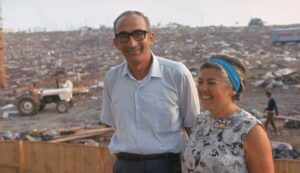
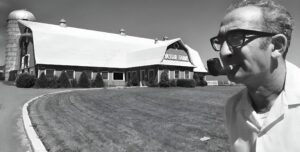
Photo: Max and Miriam Yasgur, in front of the trash remaining on their dairy farm, after the Woodstock Festival, 1969.
Appearing on stage on Woodstock’s second day, Yasgur received a hearty response when he addressed the crowd—which was much larger than he had expected. Max’s reasons were both monetary and idealistic. He was paid a reported amount of $75,000, though reports on the exact sum differ. Also, he was a pro-Vietnam War political conservative who firmly believed in the right of free expression. He once remarked to the New York Times that, “If the generation gap is to be closed, we older people have to do more than we have done.”
His neighbours gave him the cold shoulder, others threatened him with arson, boycott of his dairy products, and physical attack. His wife, Miriam Yasgur, recalled how, after her husband saw this sign “Don’t buy Yasgur’s milk” she knew darned well he was going to let them have their festival.
Max Yasgur refused to rent out his farm for a 1970 revival of the festival, saying, “As far as I know, I’m going back to running a dairy farm.” Indeed, Yasgur was neither a guitar god nor a charismatic front man. He was a farmer – but one with enough land and maverick moxie to let a young generation define itself.
Yasgur, suffered a series of heart attacks before Woodstock, and sold his farm in 1971 and relocated to Florida, where he died of a heart attack in 1973. Rolling Stone then paid tribute to him with a full-page obituary — a rare gesture for a non-musician. In 1984, at the original festival site, land owners Louis Nicky and June Gelish put up a monument marker with plaques called “Peace and Music” by a local sculptor from nearby Bloomingburg, Wayne C. Saward.
Legal Suits:
For alleged damages caused by the festival attendees, some neighbors sought legal restitution. The owners of the adjacent farm sued Yasgur for $35,000, charging that large numbers of concertgoers used their property as a site of shelter and defecation and left their property strewn with refuse. Indeed, the festival had been largely lacking in sanitary facilities. This deficiency, combined with heavy rains and a spirit of chaos by the “hippis” made a rancid mess. Yasgur’s own farm incurred damage, for which he ultimately received a $50,000 settlement from its organizers.
The organizers also reached a settlement with an indignant local farmer who claimed his cows refused to give milk during the festival’s commotion. Yasgur was the one who had to face the resentment of townspeople with whom he had previously been on good terms. Eventually, some in the community decided to hold a dinner event in his honor, just to show him that not everyone had turned on him.
About 80 lawsuits were filed against Woodstock Ventures, primarily by farmers in the area. Later on, the movie Woodstock ((1970 Documentary) financed settlements and paid off the $1.4 million of debt (equivalent to $12.3 million today) Roberts and Rosenman had incurred from the festival.
Sound:
Sound was engineered by Bill Hanley. “It worked very well”, he said. “I built special speaker columns on the hills and had 16 loudspeaker arrays in a square platform going up to the hill on 70-foot towers. We finally set it up for 150,000 to 200,000 people.” ALTEC designed marine plywood cabinets stood 6 feet (1.8 m) tall, almost 4 feet (1.2 m) deep, and 3 feet (0.91 m) wide. Each of these enclosures carried four 15-inch (380 mm) JBL D140 loudspeakers. The tweeters consisted of 4×2-Cell & 2×10-Cell Altec Horns. Behind the stage were three transformers providing 2,000 amperes of current to power the amplification setup. For many years this system was collectively referred to as the Woodstock Bins.
Light:
It was engineered by lighting designer and technical director E.H. Beresford “Chip” Monck, who was hired for 10 weeks of work for which he was paid $7,000 (equivalent to $61,000 today). But his plan was curtailed as the stage roof that was constructed in the shorter time available was not able to support the lighting that had been rented. The only light on the stage was from spotlights.
1970 Documentary: Woodstock (film)
Though Woodstock had left its promoters nearly bankrupt, their ownership of the film and recording rights compensated more than the losses after the release of a hit documentary film in 1970. And the film became an Academy Award-winning documentary film Woodstock, directed by Michael Wadleigh that was released in March 1970. One captivating aspect of Woodstock was a film interview with the gentleman who cleaned the portable toilets. This 3-minute dialogue portrayed, unexpectedly and in unusual fashion, Woodstock’s sociological complexities.
Earlier Artie Kornfeld (one of the promoters of the festival) went to Fred Weintraub, an executive at Warner Bros., and asked for money to film the festival. Weintraub offered Kornfeld $100,000 (equivalent to $880,000 today) to make the film. Woodstock helped to save Warner Bros. at a time when the company was on the verge of going out of business. Wadleigh rounded up about 100 crew with no money to pay them, he agreed to a double-or-nothing scheme, in which the crew would receive double pay if the film succeeded and nothing if it bombed. However, it was a major hit for Crosby, Stills, Nash & Young and Matthews Southern Comfort. Woodstock received the Academy Award for Documentary Feature. Woodstock events were planned for anniversaries, the 10th, 20th, 25th, 30th, 40th, and 50th. In 1996, the film was inducted into the Library of Congress National Film Registry. In 1994, Woodstock: The Director’s Cut was released and expanded to include Janis Joplin as well as additional performances by Jefferson Airplane, Jimi Hendrix, and Canned Heat not seen in the original version of the film.
Woodstock Site Today, a Museum at Bethel Woods:
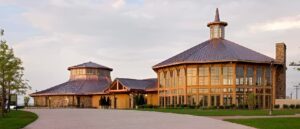
The field and the stage area remain preserved and are open to visitors as part of the Bethel Woods Center for the Arts after being purchased in 1996 by cable television pioneer Alan Gerry. It was inaugurated on July 1, 2006, with a performance by the New York Philharmonic on a newly constructed pavilion stage located about 500 yards (460 m) off the site of the 1969 stage. (The site of the original stage is vacant except for a commemorative plaque which was placed in 1984.) In June 2008 the Bethel Woods Center opened a museum dedicated to the experience and cultural significance of the Woodstock festival. The Museum is now the home to a permanent exhibit that features interpretive text panels, 20 different videos, over 300 photographs and 164 artifacts. With its 6728 square feet, the museum is divided into various sections that examine the 1960s and the festival.
Local Economic Impact:
Woodstock still acts as an economic engine for the local economy. A Bethel Woods report from 2018 indicates that 2.9 million visitors since 2006 and 214,405 visitors in 2018, an equivalent of 172 full-time jobs exist as a result, which includes direct wages of $5.1 million from Bethel Woods in Sullivan County.
References:
https://www.woodstock.com/lineup/
https://en.wikipedia.org/wiki/Woodstock
https://www.britannica.com/biography/Max-Yasgur
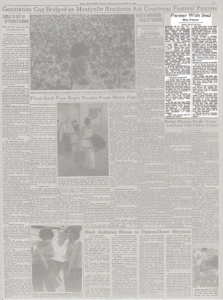
https://www.nytimes.com/1969/08/18/archives/farmer-with-soul-max-yasgur.html
https://time.com/collections/woodstock50/5648246/woodstock-bert-sommer/
https://americanhistory.si.edu/explore/stories/remembering-woodstock
https://www.bethelwoodscenter.org/news/detail/santana-50-years-of-peace-music
https://time.com/collections/woodstock50/5645555/woodstock-max-yasgur/
******



Add comment