
 Asim Deb
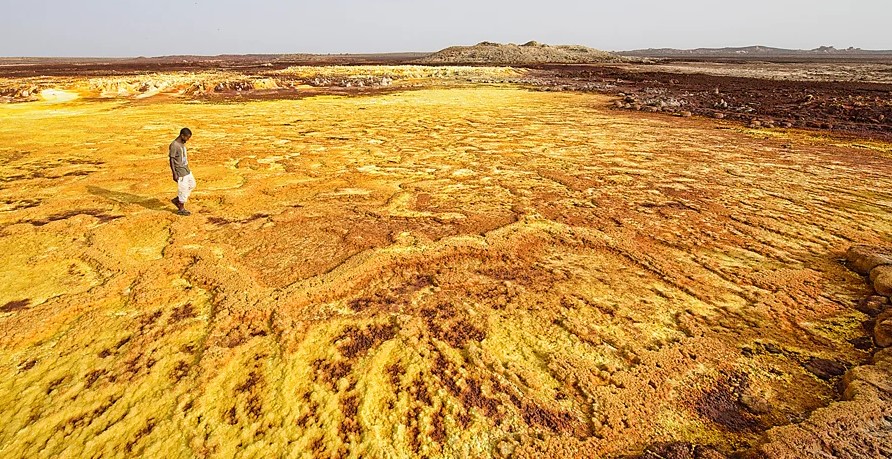
Dallol, North-Eastern Ethiopia, the Hottest Human Inhabited Place on Earth.
Compiled by: Asim Deb
Question is not where is the hottest place of the earth?
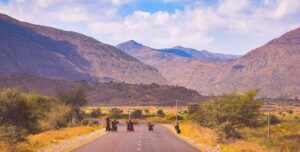
Question is where is the hottest human inhabited place on our earth? The answer is Dallol, Ethiopia, a town you would brace yourselves and enter the “Gateway to Hell” that’s what is more commonly known. If measuring strictly by the highest temperature ever recorded, then the Death Valley, California (USA) holds the official world record at 56.7°C (134°F). However, Dallol wins the title for sustained, year-round average heat where people live and work. Dallol holds the record for the highest average annual temperature of any inhabited location on Earth, with a mean temperature of about 34°C to 35°C (93°F to 95°F), with daytime temperatures frequently soaring above 49°C (120°F).
The Dallol volcano, in the northern part of the Danakil Depression, was formed in 1926 by a phreatic eruption, when the groundwater was heated by magma – essentially, a steam eruption without the lava ejection. Dallol has an elevation of approximately 50m below sea level.
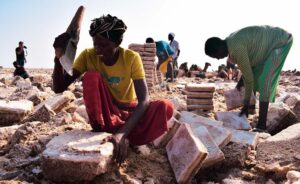
Scientists say, Dallol and the lowland of Danakil was one inundated with the Red Sea. The Sea retreated but left the salt lakes, volcanoes and the hot springs. So, Danakil is a depression like our Rann of Kutch, India or Salar de Unari in Bolivia, it has a close proximity to the sea and a dried up course of river. Tonnes of salt mines is one of the few resources the land offers. An entire community, known as Afar, live in the sparse supply of water, food, and other resources. They own the land and the camels. A small leather bottle is their constant companion where they fill up water. That helps them run the show despite lethal heat. Many Europeans and Israelis universities conduct research and find traces of human lives from the Afar region, often known as the Cradle of Africa.
Touted as one of Earth’s most volcanic regions, Dallol in Danakil Desert is long been abandoned, except a few locals, or ‘Afar’ as they are called, the region is hardly visited by tourists. Wonder why? Crazy? Yes, to begin with, if you think you can beat the Sun’s heat, think again. The heat of Dallol can not be described by words and adjectives. Afar tribe pushes away humans and livestock during the soaring summer. To add, Afar people deal with frequent earthquakes and exposed to the molten core as well. Unlike typical volcanoes with classic cones and lava flows, Dallol is built upon a massive salt plain. Magmatic fluids interact with thick underground salt deposits, There are lakes of potent acid present just beneath the ground and chances of survival are extremely bleak should you step in it.
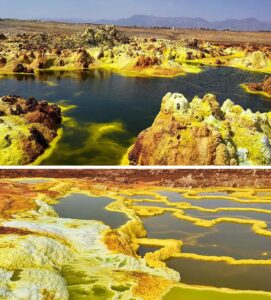
Photo: The Danakil contains stunning geological wonders (Credit: Dave Stamboulis)
Dallol, sitting 130 meters below sea level, it is famous for a stunning, toxic landscape of neon-green, bright yellow, and red sulfuric acid pools. The kaleidoscopic greens, yellows, reds, and whites are formed by the oxidation of minerals like iron and sulfur, combined with rapid evaporation. At a first glance, people might mistake it for spring bloom. Only until the sun rises to highlight the fumes coming out of the sulphur lake. The guide will shout at you not to touch or go near the water. The water is also incredibly acidic (often approaching a pH of 0), making the pools highly corrosive. Lake Assale has only a one cm high water lake.
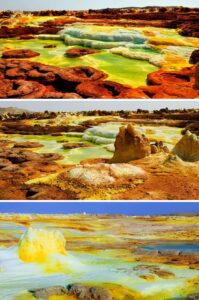
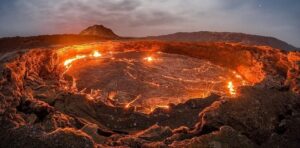
The Danakil Depression, formed by the collision of several tectonic plates on the Ethiopian, Eritrean and Djibouti border, is a place of stunning geological wonders. The majority of travellers who come here do so to visit Erta Ale, a 600m-high and highly active volcano that contains the largest living lava lake in the world. The volcanic lunar landscape resembles a surrealist painting, with sulphurous hot springs, lava beds, hypothermal pools, and a mix of sulphates, iron oxides and salt deposits all combining to create a hallucinogenic palette of otherworldly formations and colours. So, Dallol is a perfect example of nature’s beautiful yet extreme side, as the place impresses with otherworldly landscape and scorching temperatures.
A young Afar camel herder named Mohammed, tells that his father could cut 150 bricks in a day, worth a bonus as most workers earn their daily rate chopping up around 120. However, Mohammed has opted for an easier job but that pays less: that of loading and walking the camels. He guides a group of 15 to 20 dromedaries, each laden with 30 salt bricks that weigh 4kg each, through the desert to the small hamlet of Berahile, an 80km trek that takes two to three days each way. The team receives about 3,320 Ethiopian Birr (£112) for the journey, but most of this goes to the camel owner and the food for the camels, while Mohammed and one other assistant get a paltry remainder.
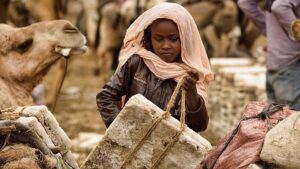
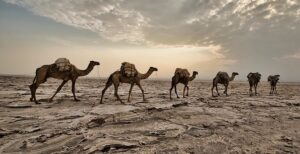
For the Afari people, camel caravans are a harsh daily reality, as the shepherds leading the caravans are not used to any luxury, even they usually walk barefoot or with flip-flops and do not walk a mere 20 kilometres going from Mekele to the salt plains year after year, setting camps along the way and living mainly on porridge and milk since their arid land yields nothing else. Their livelihood has not changed in two thousand years, they transport salt back and forth until they are too warn out to continue.
One of Dallol’s most iconic features is the Dallol Volcano, which last erupted in 1926. The volcano is surrounded by hot springs and fumaroles that release a variety of minerals and gases. Sulfur, potash, salt, and other minerals contribute to the vibrant hues of yellow, green, and red that paint the landscape, making Dallol look like an artist’s palette set in the midst of a desolate desert.
Ghost Town Origins
Dallol was historically an active potash and sulfur mining settlement during the Italian occupation in the early 20th century. Today, it is an abandoned ghost town. The only regular human presence comes from Afar camel caravans that continue to traverse the harsh region to mine and transport salt blocks. Once every week, they take their camels to Addis Ababa, and sell the salt (kosher) for as low as 20 USD. They come back all the way to Dallol, with gentle following of the camel caravan, only to start mining again.
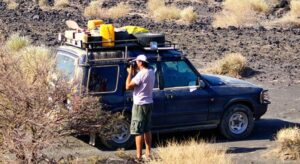
Because of the harsh conditions and feared attacks, tourists needs to plan carefully. Going there requires to travel in a 4×4 convoy (in case a car breaks down) with experienced guides and drivers and enough food and water to last for the six-day trip, bringing mattresses and sleeping gear, contracting local armed militia escorts and in some places, around Erta Ale in particular, paying army soldiers to give protection. It is so remote that even the GPRS phone system doesn’t reach.
The Afar people are renowned in Ethiopia for being an ethnic group of their own with different customs. They are feared for their tradition of killing as many enemies as possible to be considered a man and for keeping their testicles as trophy.
Berhale is the first town in Afar land. Besides an administrative stop, Berhale is also the first trading halt for the camel caravans carrying salt from Danakil to the main market in Mekele.
Dallol is a mix of danger and beauty, and it’s difficult to say which is more captivating. At one side, there is adventure at its extreme. On the other, the salt-encrusted colorful lakes are a sight to behold. The brown mound, or the volcano, is the only vertical structure. Combined with hot springs and iron oxide crust and geysers, the landscape of Dallol craters is truly mesmerizing.
For transportation of Ethiopian salt, the first railway was constructed between the mining site and Eritrean port by the year 1918. However, the weather was too extreme to endure and production was stopped after World War I. After several unsuccessful attempts by companies to renew operations, the British dismantled the rail system for good. Today, the remains of trucks and rail carriages can be seen strewn across the never-ending white salt flats.
It was in the 1960s that some of the American mining companies conducted geological surveys at the place that revealed a maximum temperature of 46 degrees on a regular basis. It soon became the place with the highest recorded average temperature in any inhabited place on earth. The only time in the year that this average temperature would dip down to below 37 degrees was in the months of January and February.
References:
https://www.bbc.com/travel/article/20160913-inside-ethiopias-sizzling-cauldron
https://timesofindia.indiatimes.com/travel/destinations/life-in-dallol-ethiopia-the-hottest-inhabited-place-on-earth/articleshow/107203132.cms
https://www.makemytrip.com/tripideas/blog/dallol-ethiopia
https://www.livescience.com/life-not-found-most-extreme-pools-dallol-ethiopia.html
*******





আমি ডালল (Dallol) বিষয়ে আগে কিছুটা পড়েছি, তাই কিছুটা ধারণা আছে।
ডালল সৃষ্টিকর্তার শৈল্পিক বোধের এক অনন্য নিদর্শন। এখানের প্রাকৃতিক সৌন্দর্য কল্পনাতীত, যদিও অন্যভাবে এক চরম রুক্ষ প্রকৃতির বহিঃপ্রকাশ। এর চমৎকার ভূ-দৃশ্য, যা দেখে মনেই হতে পারে যে কোনো শিল্পীর নিপুণ তুলিতে আঁকা রঙ বেরঙের একটি কার্পেট। এখানের দৃশ্য দর্শনার্থীদের মুগ্ধ করবে ঠিকই, কিন্তু এখানের অস্বাভাবিক তাপমাত্রার কথাও মাথায় রাখতে হবে। মনে রাখবেন, এটি পৃথিবীর সবচেয়ে উষ্ণ জনবসতিপূর্ণ স্থান, যেখানে দিনের বেলা তাপমাত্রা অনায়াসেই ৪৯ ডিগ্রি সেলসিয়াস ছাড়িয়ে যায়। আগ্নেয়গিরি, তীব্র তাপ এবং সমুদ্রপৃষ্ঠ থেকে অত্যন্ত নিচু অবস্থান – সব মিলিয়ে এখানকার পরিবেশ মানুষের বসবাসের জন্য অত্যন্ত প্রতিকূল ও চ্যালেঞ্জিং; তা সত্ত্বেও মানুষ এখানে বসবাস করে। আফার (Afar) উপজাতির মানুষরা তাদের সাধারণ জ্ঞান ও অভিজ্ঞতায় ভর করে এবং কঠোর পরিস্থিতির সাথে মানিয়ে নিয়ে প্রজন্মের পর প্রজন্ম ধরে ডাললকে তাদের আবাসস্থল হিসেবে টিকিয়ে রেখেছে।
সাহসী ভ্রমণপিপাসুদের কাছে ডালল ভ্রমণের অভিজ্ঞতাটি হতে পারে এক বড় চ্যালেঞ্জ তবে মনে রাখবেন, এতে ঝুঁকিও রয়েছে!