
 Asim Deb
Life & Works of Rai Bahadur Sir Ganga Ram, Civil Engineer and Architect.
Compiled by Asim Deb.
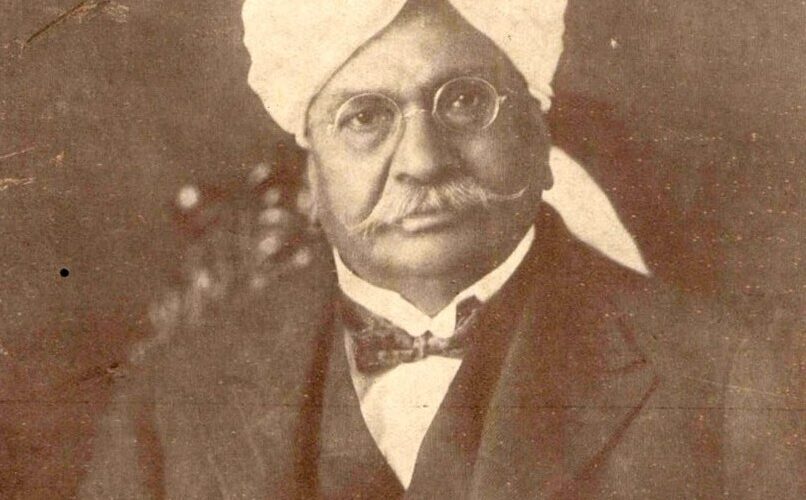
Rai Bahadur Sir Ganga Ram (born Ganga Ram Agarwal; 13 April 1851 – 10 July 1927), CIE MVO (Royal Victorian Order) was an Indian Civil Engineer and Architect of undivided India’s era. In view of his extensive contributions to the urban fabric of Lahore, then part of undivided India, journalist Khaled Ahmed described him as “The Father of Modern Lahore”.
He was born on 13 April 1851 in Mangtanwala, a village in Sheikhupura District in the Punjab Province of undivided India (now in the Nankana Sahib District of Punjab, Pakistan) in a Agrawal Punjabi Hindu family. His father, Doulat Ram, was a Junior Sub-inspector at a police station in Mangtanwala. Later, he shifted to Amritsar and became a copy-writer of the court. There, Ganga Ram completed his matriculation examination from the Government High School and joined the Government College, Lahore in 1869. His higher education marked him travel across northern India and Pakistan as he went to Lahore to study at the government college, and then in 1871, he received a scholarship to the Thomason Civil Engineering College, Roorkee (now IIT Roorkee). From the 50 rupees of his scholarship, he would send half to his parents in Amritsar to supplement their income. He passed the final lower subordinate examination with a gold medal in 1873, and joined as an apprentice in the office of Rai Bahadur Kanhaya Lal, the then Chief Engineer of Lahore. Here began the “Ganga Ram period” in Lahore’s architecture. He went on to become a top civil engineer and shaped the architecture in the city through his work.
In 1873, after a brief Service in Punjab P.W.D., he devoted himself to practical farming. He took, on lease 50,000 acres (20,000 ha) of barren, unirrigated land in Montgomery District, from the government. Within three years he converted that vast desert into fields, irrigated by water lifted by a hydroelectric plant and running through a thousand miles of irrigation channels, all constructed at his own cost. This was the biggest private enterprise of the kind, unknown and unthought-of in the country before. Sir Ganga Ram then earned millions most of which he gave to charity.
Ganga Ram worked with the railways on the strategic Amritsar-Pathankot railway line project, that drew the attention of the then Viceroy and Governor-General of India, George Robinson, who sent him to Bradford Technical College (now the University of Bradford) in England, for a two-year course in Water Works and Drainage. It was a stint that not only helped him develop but also revolutionise Punjab’s agriculture just a few years later.
In 1885, Ganga Ram returned from England to Lahore, where he would pilot and execute the most prestigious and challenging project of his life – the rebuilding of Lahore. After centuries of being a provincial capital under the Delhi Sultanate and the Mughals, Lahore had also been the capital of the Sikh Empire of Ranjit Singh. However, after the fall of his Empire to the British in 1849, all the Mughal and Sikh monuments, gardens and mausoleums were left to decay, thus robbing the city of its royal splendour. During the Sikh rule, Amritsar, not far away, had emerged as the economic centre of the Sikh Empire and North India. Amritsar continued to thrive under the British while Lahore lagged behind cities like Delhi, which had regained some of the economic prosperity they had lost after the Revolt of 1857. So, in the last two decades of the 19th century, the British decided to rebuild Lahore from the ashes of its Mughal past.
The new city had to be modern and the dominant architectural style chosen was Indo-Saracenic, a blend of traditional and Indic art. Ganga Ram, who had been already working for the Public Works Department in the city, was appointed as the Executive Engineer of Lahore.
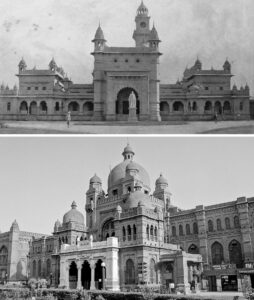
Ganga Ram was appointed for the project, and now he is credited with designing and constructing several modern style magnificent buildings of that time, a few examples: General Post Office, Lahore, Ganga Ram Free Hospital and Dispensary, Lahore (1921), Lady Mclagan Girls High School, the Chemistry Department of the Government College University, the Albert Victor wing of Mayo Hospital, Sir Ganga Ram High School (now Lahore College for Women), the Hailey College of Commerce (now Hailey College of Banking & Finance), Ravi Road House for the Disabled, the Ganga Ram Trust Building on “The Mall” and Lady Maynard Industrial School. He also planned and constructed Model Town and Gulberg town, once the most prestigious localities of Lahore, and also powerhouse at Renala Khurd as well as the railway track between Pathankot and Amritsar. The construction of Lahore Museum, Aitchison College and Mayo School of Arts (now the National College of Arts) was supervised by him as well. He also gave Lahore a new waterworks, in addition to many other buildings.
By 1900, the then Viceroy and Governor-General of India, Lord Curzon, was so impressed with his engineering works that Ganga Ram was appointed Superintendent of Works for the Imperial Durbar to be held in Delhi in on the occasion of the accession of King Edward VII to the throne. The Durbar was to be held in 1903 and Ganga Ram fulfilled his brief and exceeded expectations. Then, after serving as the Executive Engineer of Lahore for 12 years, Ganga Ram announced his premature retirement at the age of 52, in 1903. That same year, he was conferred the title of ‘Rai Bahadur’ and appointed a Companion of the Order of the Indian Empire (CIE) for his services at the Delhi Durbar.
On 12 December 1911, in a special honours list after the 1911 Delhi Durbar, he was appointed a Member Fourth Class (present-day Lieutenant) of the Royal Victorian Order (MVO). He was Knighted in the 1922 Birthday Honours list, and on 8 July was personally invested with his honour at Buckingham Palace by the King-Emperor George V.
Ganga Ram used arches and other Indian architectural traditions while employing western construction devices to protect them from the heat and cold of the climate in the Punjab province and ensure efficient and unobtrusive sanitation. Renowned Pakistani journalist Khaled Ahmed described Ganga Ram as as “the father of modern Lahore,” for the indelible mark he left on the city.
Service in Patiala State:
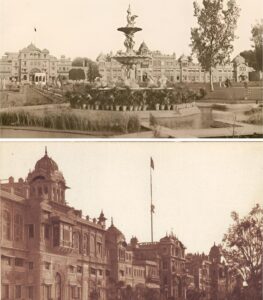
At the time, Maharaja Bhupinder Singh of the princely state of Patiala in Punjab (India), wanted to redesign his state and give it a modern outlook just like Lahore. Ganga Ram was his obvious choice to pilot the project. The brilliant engineer was persuaded to emerge from retirement and, as Superintending Engineer, supervised the reinvention of Patiala. Today, Moti Bagh Palace, the Secretariat, Victoria Girls High School, City High School, Law Courts and Ijlas-e-Khas building bear the stamp of his work.
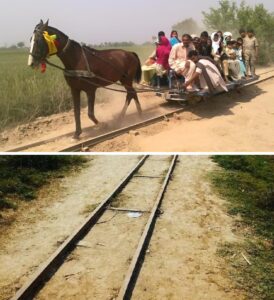
In Tehsil Jaranwala of district Lyallpur (now Faisalabad), Ganga Ram built a unique travelling facility, Ghoda Train (horse pulled train). It was a railway line from Buchiana Railway station (on Lahore Jaranwala railway line) to the village of Gangapur. It was unique of its kind. It was two simple trollies pulled on a narrow rail track with horse instead of railway engine. In 1980s, the line was abandoned because of lack of maintenance. And then then the track was also stolen. But it was revived in 2010, as the local people say, “the facility was an antique and historical thing that reflected the vision of Sir Ganga Ram”. The horse driven trolley that we see in the photo was built in 1898.
Agriculturist:
His great achievements, however, was successful experiments he made in the application of scientific methods of cultivation in Indian agriculture. Ganga Ram was keen to attempt the irrigation system he had set up in Gangapur on a bigger scale. While working in Patiala, Ganga Ram had the post-plans which were concerned with utilising the skills he learnt at Bradford when he was sent to England by government years ago. In 1893, he took barren land on lease from the Government near Renala, and cultivated it by completely irrigating the barren land with hydro-electric pumping. That after he retired in 1903, he was granted twenty squares of land in the crown waste area of Lower Chenab canal. He was subsequently granted further large areas of high land on condition that he should irrigate them by steam-power and electricity. Finally, through government’s subsidy and his vast personal savings which he had earned by then, he took on lease the 50,000 acres of barren land in Montgomery (now Sahiwal) and Renala Khurd, from the government, both in present-day Pakistan’s Punjab Province.
He founded a village named ‘Gangapur’, which housed the first farm in India to introduce a mechanical reaper and ridge, harrows, scythes, sprays and other modern agricultural implements.
The success of his farms resulted in a proposal in 1917 by the Punjab Government that he should accept the lease of 23,000 acres of high-level land for three years, the stipulation being that he should return the land, fully equipped and irrigated, at the end of that period for its colonization by ex-soldiers of the Indian Army. His resources and talent were such that he successfully fulfilled this daring contract, and within three years, Ganga Ram could convert that vast desert territory into fertile fields irrigated by water lifted by a hydroelectric pumping plant and running through channels. Then he was given a further lease of a much more extensive area of land in the Lower Bari Doab Canal tract, to develop for the same purpose within a period of seven years. In this case provision had to be made for the cultivation of the land by hydro-electric machinery, and at the site of the power house a head of only two feet was available. By regrading the canal this was converted to a fall of six feet. Five special turbines of horizontal type were designed, each giving 220 horse-power, and commanding in all about 125 square miles.
It was one of his most ambitious projects of that time: the hydel power project in Renala Khurd in Punjab province. Undoubtedly, he was the pioneer in applying engineering in agriculture using modern irrigation methods. The project, which was officially opened in 1925, used five turbines to irrigate 360sq.km (139 sq miles) of wasteland and transform them into fertile fields.
The work included the construction of 72 miles of irrigating channels, 626 miles of watercourses, 45 bridges, 565 miles of village roads, 121 miles of boundary roads, 129 outlets and 640 culverts. The whole of this great scheme was completed before April 1925 as agreed. These works made Sir Gangs Ram one of the wealthiest men in India, but the noble use to which he put his riches was referred to in the tribute which the Governor of the Punjab paid to him on the completion of his last great work: “If he wins like a hero, he spends like a saint.” Throughout his career Sir Gangs Ram retained his grip of the details of engineering science and was the author of a Pocket Book of Engineering published in Lahore.
He died in London on 10 July 1927. His body was cremated and his ashes were brought back to India. While Pakistan’s Lahore city was his home, during the 1947 Partition of India, his family moved to Delhi in India.
After the partition of India and Pakistan, in 1951, another hospital with his name – Sir Ganga Ram Hospital was built in New Delhi. On 26 November 1957 a student hostel, Ganga Bhawan was established at IIT Roorkee (erstwhile University of Roorkee and Thomason college of civil engineering) in his honour. On 27 May 2009, Sir Ganga Ram Hospital in Lahore, Pakistan was partially damaged in the blasts that destroyed a nearby Police Station.
There are very few personalities in India and Pakistan who left a legacy as lasting on both sides of the Indian border as an iconic engineer and also a philanthropist, Sir Ganga Ram. Hospitals in Delhi and Lahore – built by his trust and family in his name – continue to uphold his legacy to this day.
Ganga Ram died in 1927, but writer Sadat Hasan Manto’s short story, The Garland, summed up just how much the man and his legacy is intertwined with the city of Lahore. In the story, said to be based on a true incident during the Partition, a mob attacks Ganga Ram’s statue in front of his hospital to wipe out his Hindu name. But when a man is injured, the mob shouts, “Let us rush him to Sir Ganga Ram Hospital.”
From Engineer to Philanthropist:
In 1917, Ganga Ram tried to pass a resolution on widow re-marriage at a religious Hindu conference in the province’s Ambala city. When it failed, he founded the Widows’ Marriage Association and donated 2,000 rupees (a large sum at the time) from his own money to it. The association would raise awareness about the difficulties of widows faced in society. Ganga Ram soon realised that while some of the widows were too old to re-marry, many of them did not want to marry again. In 1921, with
the government’s approval, Ganga Ram built a Hindu Widows’ Home in 1921, costing 250,000 rupees, to train such women with skills to support themselves. The home would go on to have two schools and a hostel. It would help the widows pass examinations and train them to become teachers of handicrafts.
Ganga Ram also funded the establishment of Lady Maynard Industrial School for Hindu and Sikh women who faced financial difficulties.
He established a Maynard-Ganga Ram award of Rs 3000 with a Rs 25000 endowment. The award was to be made every three years for anyone who made an innovation that increased agricultural production in Punjab.
In the early 1920s, the Akali movement was launched by Sikhs in Punjab to regain control of the gurdwaras from the Udasi Mahants. One of the most strident campaigns was the one at Gurdwara Guru-ka-Bagh, near Ajnala in Amritsar district. Here, the Mahants with the help of the British government had arrested and thrashed hundreds of Sikh volunteers, who were agitating for control of the land on which the gurdwara stood. Empathising with the Sikhs, Sir Ganga Ram stepped in and took the land on lease from Mahant Sundar Das, thus giving the Akalis access to their shrine. He later persuaded the government to release 5,000 Sikh volunteers. Ganga Ram is thus considered a highly respected name in the Sikh community.
Ganga Ram was now in his 50s. He was rich and socially powerful and had achieved so much that he now wanted to give back to the people. After executing so many welfare works on behalf of the government, he decided to build some with his own money. In 1925, Ganga Ram presented to British India’s Punjab Provincial Government a sum of Rs 25,000 as an endowment for a prize, to be called the ‘Maynard-Ganga Ram Prize’, which was to be awarded every three years, for discovery, an invention or a new practical method which would increase agricultural production in Punjab. The competition is still operational and open to all.
Ganga Ram’s last charitable project during his lifetime was the establishment of the Hindu Apahaj Ashram over two acres of land. This was a home for the elderly, the disabled and the infirm. After his death in July 1927 in his London home, some of his ashes were brought back to Lahore and buried next to Hindi Apahaj Ashram as per his wishes. While the ashram is no longer here, his tomb, the Ganga Ram Samadhi, still stands. Sir Ganga Ram Free Hospital and Dispensary was later developed as a full-fledged hospital with well-equipped surgical and medical departments. It was the second only to Mayo Hospital, the oldest and biggest hospital in the Punjab province. The trust also established a Hindu Student Careers Society in 1924 to help Hindu students gain employment and the Sir Ganga Ram Business Bureau and Library.
He died during a visit to London as a member of the Royal Agricultural Commission, on 10th July 1927. His samadhi or mausoleum is in Lahore and a statue of him stood in a public square on Mall Road, a locality that boasts many of the monuments he built.
References:
Wikipedia
https://www.bbc.com/news/world-asia-india-62499647
https://www.livehistoryindia.com/story/eras/ganga-ram
https://www.nation.com.pk/14-Jul-2021/sir-ganga-raam-a-noble-soul
https://navbharattimes.indiatimes.com/astro/spirituality/motivational-stories/know-who-was-sir-gangaram-after-whose-name-a-hospital-is-built-in-delhi/articleshow/91339559.cms
https://www.news18.com/india/sir-ganga-ram-the-indian-engineer-pakistan-still-remembers-with-respect-ws-dkl-9431893.html
https://www.gracesguide.co.uk/Ganga_Ram
https://kids.kiddle.co/Ganga_Ram
https://irfca.org/articles/horse-tram-pakistan.html
********





ভাল হয়েছে |
স্যার গঙ্গারাম যে কোন লোকের, বিশেষ করে ইঞ্জিনীয়ারদের কাছে আদর্শ পূরুষ হতে পারেন | নিজের কাজে অসামান্য পরিদর্শিতা ছাড়াও নিজের ওপর বিশ্বাস, সমান তালে ইংরাজদের ওপর ছড়ি ঘোরানো (ভাইসরয় ওনার অতিথি হয়ে ধন্য হয়েছিলেন), একজন সফল ব্যাবসায়ী এবং সর্বপরি সমাজের প্রতি দায়বদ্ধতা ওঁকে একজন নমস্য পুরুষ বললে কমই বলা হয়।
শ্যামল মিত্র
বি ই কলেজ, সিভিল ১৯৬৭|