
 Asim Deb
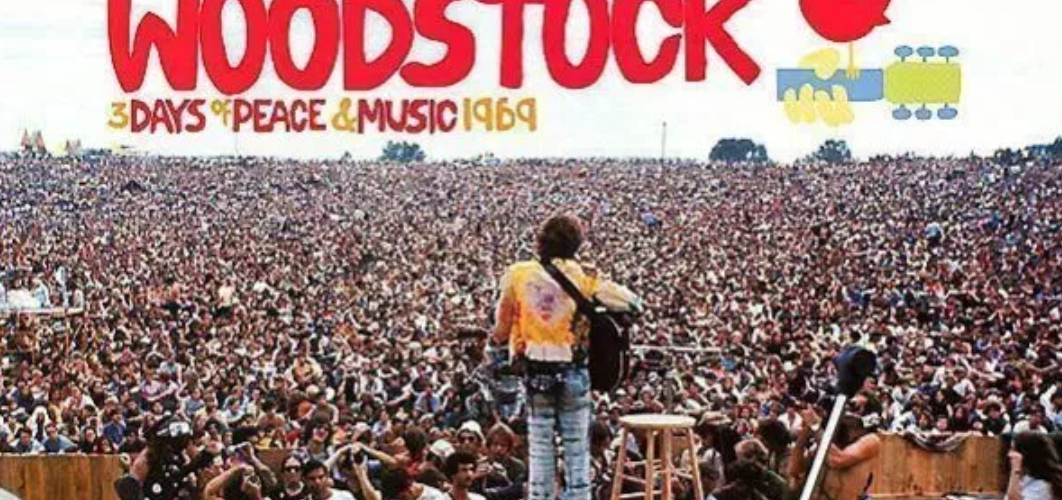
Open Air Musical Show & Woodstock 1969: 4,00,000+ Audience In a 3 Day’s Pop Music Festival.
Compiled by: Asim Deb
From ancient Greek and Roman history, we find the references of permanent structure of open air theaters.

Moghul emperor Akbar also had an open air theatre at Fatepur Sikri, and we find the reference of Tansen performing there. However, with the social demands of the common men for more and more functions, we have built auditoriums, but that had the restrictions of capacity. And whenever we have thought of huge crowd, though not frequently, organisers opted for open air functions.
During ’60s and ’70s, the Kolkata বঙ্গ সংস্কৃতি সন্মেলন used to organise musical shows every year at the Maidan, stretching it almost for a month. In February 1968, the “Ashok Kumar Nite” was a highly publicized cultural and musical show at the Calcutta Rabindra Sarobar, with 50,000 strong crowd. It featured Bollywood actor Ashok Kumar, and singers and stars like Mohammad Rafi, Mukesh, Manna Dey, and Mehmood. However, the show failed initially due to faulty sound system, resulting a chaos, and the stampede, amidst many women were molested and sexually abused en masse. Though it was a ghastly incidence, it was one of the most talked Indian open-air concerts in mid last century.
However, India’s grand entry into the international rock music can be attributed to the legendary Afro-Caribbean band Osibisa, when they made historic tours of India in the early 1980s. They arrived with 28 tonnes of sound and musical equipment at the then shipment cost of Rs 3.60 lakh. Their debut tour in 1981, spanning Delhi India Gate lawn, Kolkata ITF Pavilion Ground (opposite Park Street). For Mumbai, it was NSCI indoor stadium, Bangalore’s Nehru Stadium, and Chennai Sir Mutha Venkatasubba Rao Concert Hall and Corporation Kalaiarangam. Anyway, Osibisa’s arrival raised India’s expectations for more such concerts.
In recent times, in January 2025, the world’s renowned Coldplay band performed three days at Navi Mumbai’s D.Y. Patil Stadium, and two days at the Narendra Modi Stadium in Ahmedabad. Mumbai had three sold out shows of 63,711 tickets for $12,819,848. Then Coldplay made history in India, selling 223,570 tickets for $15,696,814 gross at the world’s largest cricket stadium, Ahmedabad, with over 111,000 fans each night. According to EY-Parthenon and BookMyShow Live report, Coldplay’s Ahmedabad concerts generated ₹641 Cr of revenue, with ₹72 crore in GST revenue to the Government of India.” Western Railway introduced special superfast trains between Mumbai and Ahmedabad. The city’s airport handled 138,000 travelers during the three days, while the local metro system shattered all previous passenger records. Hotel room rates that typically hover around ₹15,000 even during peak season, but that soared to even ₹50,000 – ₹90,000. Ahmedabad’s infrastructure proved resilience, creating seamless, world-class visitor experiences and sustainable:
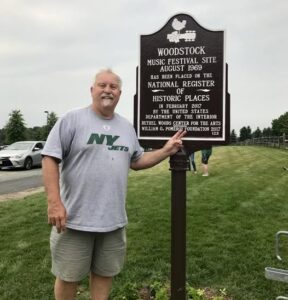
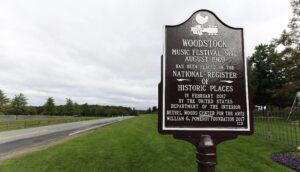
Whatever I said so far, be it Osibisa or Coldplay, these were the repeat shows of the same program at different cities, on different dates, in a single tour. So, then which one may be considered as the greatest musical open-air show in terms of audience and without any repeat show in a single tour? For the answer, the only name that comes in our mind is the Woodstock show of 1969, where 4,00,000+ audience attended a 3 days’ live music festival, even during the rain, with some of the world’s best musicians. Just imagine – because of a musical event, that site in an unknown village milk dairy farmhouse is now a preserved site “National Register of Historic Places” of the US Ministry of Interiors, and people put up a monument marker with plaques called “Peace and Music”.
Now think of a 3 day’s open air pop music festival that was organised 50 years back in America:
• 4,00,000+ audience against the sale of 186,000 advance tickets. Organisers could not resist the rest of the people who were without tickets.
• The western pop music festival was inaugurated by an Indian Yoga Guru.
• Pandit Ravishankar in Sitar and Allarakha in Tabla performed in rain in the open-air stage.
• Looking at the gathering, Sullivan County declared a state of emergency. Governor of the state and the future Vice President Nelson Rockefeller offered 10,000 National Guard troops to secure law and order.
• Nearby Stewart Air Force Base helped to air-lift performers in and out of the site. And supply food, water and emergency medical helps for 3 days, when the roads became impassable.
• Radio and television discouraged people from setting off to the festival, announcing that the New York State Thruway was closed.
• Helicopter surveillance marshaled local authorities, health care providers and electricity, the US Army, and an eccentric outfit known as Hog Farmers, to avert public health disaster. Team of overworked doctors treated close to 2,500 people in 3 days.
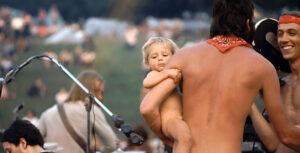
• Two births, one in the car and one in the helicopter.
There were all the reasons and possibilities for a “major human tragedy” but the festival was remarkably peaceful and successful, given the huge crowd and the conditions involved.
Yes, unbelievable, but true.
At resent, the US Department of Interior preserves the event site as The National Register of Historic Places. Also, now there is a museum dedicated to the experience and cultural significance of the Woodstock festival. So, originally a unknown and most common dairy firm house, after hosting a musical event, becomes a historic site for music.
********
The time was early days of year 1969.
America was disturbed: politically and socially. Martin Luther King was assassinated in last April 1968. US army was under global criticism for their invasion of Vietnam. Mohammod Ali was criminally convicted with five years in prison, and fined $10,000 for refusing to join the army. And students around the whole country were on the protests against occupying Vietnam.
So, a group of young Americans were searching for their place within it. In that time of conflict and uncertainty, they thought of three days of peace and music, that seemed to be just what a divided nation needed. The plan was big, even if the organisor can make 50% success it would be a remarkable event. Promoters John Roberts, Joel Rosenman, Artie Kornfield and Michael Lang envisioned the festival as a way to raise funds to build a recording studio and rock-and-roll retreat near the town of Woodstock, New York. But that needs huge money, huge setup, Organisers had to think for a ground that would accommodate so huge rush; their food, water, healthcare, sanitation, traffic and transport, electricity, rain and mud, law and order, security, drug control, environment protection, resting place, ….. a long list. So, at the end, organisors should ensure “no human tragedies”, specially to care for senior citizen, physically disabled music fans, and the crazy fans who might bring their little child.
The Indian yoga and religious Guru Sri Swami Satchidananda, inaugurated the show. He was co-founder of the Center for Spiritual Studies in New York with his own brand of Integral Yoga.
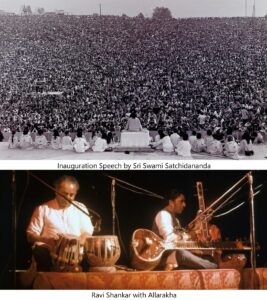
Ravi Shankar, with Allarakha in tabla were for sure someone very special for this festival. During Woodstock, it was raining, and throughout the rain, they started at about 10 pm on Friday evening and played for over 40 minutes.
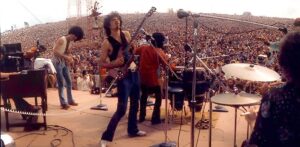
A total of 32 musical acts graced the Woodstock stage. 13 were lead artists with backing bands and 19 were group. Altogether, 163 musicians performed on the festival’s main stage! Specially to mention, Santana brought the Latin Rock Fusion to Woodstock. They started at 2:00 pm on Saturday, the 16th. Santana used a huge percussion section at that time and drummer Michael Shrieve added his personal note, especially during the drum solo of “Soul Sacrifice”.
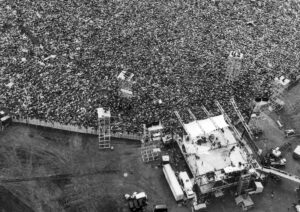
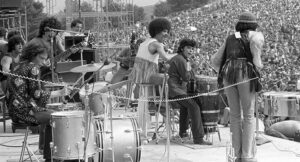
Jimi Hendrix. Hendrix appeared close out the festival on Sunday night. With delays mainly due to rain, Hendrix chose to play last, giving other artists the chance for spotlight before he comes on the satge. Hendrix performed a two-hour set, including his psychedelic rendition of the national anthem, which became “part of the sixties Zeitgeist” after it was captured in the Woodstock film.
Missed Connections:
The Beatles were recording Abbey Road at the time and on the verge of breaking up. John Lennon was invited and the Plastic Ono Band, but due to Lennon’s position on Vietnam and 1968 drug bust in England, Richard Nixon and the U.S. government reportedly did not want him in the country.
Simon & Garfunkel could not agree, as they were working on their new album.
Eric Clapton wanted English supergroup Blind Faith to play the festival, but was outvoted by the rest of the group.
Bob Dylan lived in the town of Woodstock but he signed in mid-July to play the 1969 Isle of Wight Festival on August 31.
Led Zeppelin were asked to perform. Their manager Peter Grant stated: “I said no because at Woodstock we’d have just been another band on the bill.”
Planning The Program:
The original plan was for a venue in the town of Woodstock on a site owned by Alexander Tapooz, but local residents objected. Roberts and Rosenman then again searched and discovered the 300-acre (0.47 sq mi; 1.2 km2) Mills Industrial Park in the town of Wallkill, Orange County, New York, but the town residents opposed, because the Town Board had a law requiring a permit for any gathering of over 5,000 people.
Just 1 month before the scheduled event dates of August 15 to 18, 1969, they could identify a site in Bethel, New York, 60 miles (95 km) southwest of the town of Woodstock on a land belonging to dairy of farmer Mr. Max Yasgur. It was a 15-acre (650,000 sq ft; 61,000 m2) motel grounds, and had a permit for events, but only for small gathering, mostly family functions. To add, Yasgur’s land had a bowl sloping down to Filippini Pond on the land’s north side, and Filippini refused to sign a lease for the use of his property. The organizers again told Bethel authorities that they expected no more than 50,000 people. (though that number finally reached 400,000).
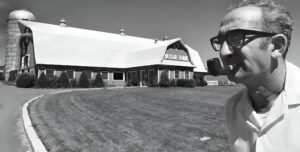
Despite opposition from the residents and signs proclaiming, “Buy No Milk. Stop Max’s Hippy Music Festival”, the Bethel Town Attorney Frederick W. V. Schadt, the building inspector Donald Clark and the Town Supervisor Daniel Amatucci approved the festival permits, but the Bethel Town Board refused to issue the permits. Organisers challenged how can you withhold a permit which had already been authorized. Finally, Inspector Clark issued the permits. The only pending job: a proceed by the Department of Health and Agriculture.
The time left was only few days, and construction engineer said to choose between (a) complete the fencing and ticket booths, otherwise the organisers would be facing almost bankruptcy, or (b) trying to complete the stage, as there might be a weekend venue for half a million people. The next morning, overnight, 50,000 “early birds” arrived and settled themselves in front of the half-finished stage. For the rest of the weekend, concert-goers simply walked on to the site with or without tickets. So, a stage in the middle of a small New York farm field ended on the world stage. Another twist, Apollo 11 landed the first man on the moon in July 1969, just a month before the Woodstock Festival. The whole of America’s TV and human attention focused on Apollo landing on moon, and marketing of Woodstock took the back seat.
Though Woodstock was conceived as a profit-making venture, but that became a “free concert” when circumstances became different. Tickets for the three-day event cost US$18 in advance and $24 at the gate (equivalent to about $200 and $250 today). Against the estimated plan of 50,000, around 186,000 advance tickets were sold. The influx of people to the rural site in Bethel created a traffic jam, that engaged a group of 346 off-duty New York City police officers to control, but the officers were forced to withdraw when they were warned that they were violating regulations against moonlighting. On the morning of Sunday, August 17, New York Governor and the future Vice President Nelson Rockefeller called festival organizer John P. Roberts and told him that he was thinking of ordering 10,000 National Guard troops to the festival site. Sullivan County declared a state of emergency. Personnel from nearby Stewart Air Force Base helped to ensure order and air-lifted performers in and out of the site. Radio and television descriptions of the traffic jams discouraged people from setting off to the festival, announcing that the New York State Thruway was closed. On the other side, helicopters were transporting food and medical supplies when the roads became impassable.
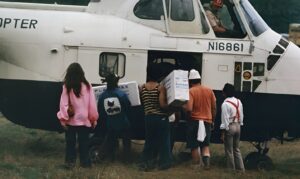
When Woodstock was underway, the neighbours sold water to the masses. Yasgur was unhappy because people should be sensible that water is not an item for money-making enterprise. So, on the side of his farm, he put up a large sign to inform everyone that he had “Free Water.”
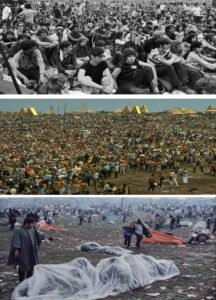
Directors realized they had the potential for one of the “greatest human tragedies in modern times”. Early estimates of attendance increased from 50,000 to around 200,000, but by the time the gates opened on Friday, August 15, about 400,000 people were clamoring to get in. The organizers found no choice but were eventually forced to make the event free of charge. Helicopter surveillance was conducted, and marshaled local authorities, health care providers, local townspeople, the US Army, and an eccentric outfit from New Mexico known as the Hog Farmers, whose extraordinary efforts averted public health disaster. Team of overworked doctors treated close to 2,500 people in 3 days. Two deaths occurred and 3000 first aid visits were recorded.
However, the festival was remarkably peaceful given the number of people and the conditions involved, although there were three recorded fatalities: two drug overdoses and another caused when a tractor ran over a 17-year-old sleeping in a nearby hayfield. Births were claimed, one in a car caught in traffic and another in hospital after an airlift by helicopter. Miscarriages were reported and over the course of the three days there were 742 drug overdoses. Drug use was a huge part of the festival, with many staying in their tents in the woods and taking LSD in groups. Teens spent time on jungle gyms, while many were guided in yoga exercises. The Voice reported that “in a way, the nudity seemed more natural and necessary than fashionable, since everyone was constantly getting drenched in the rain. By Sunday, the bathers had gotten bolder and petting each other as if it were the most natural thing in the world.”
Max Yasgur, Who Owned the Site:
Max spoke of how nearly 400,000 people in total had spent the 3 days with music and peace on their minds. He stated, “If we join them, we can turn those adversities that are the problems of America today into a hope for a brighter and more peaceful future”.
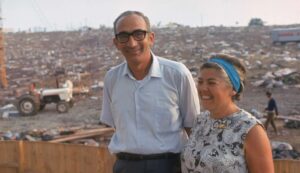
Photo: Max and Miriam Yasgur, in front of the trash remaining on their dairy farm, after the Woodstock Festival, 1969.
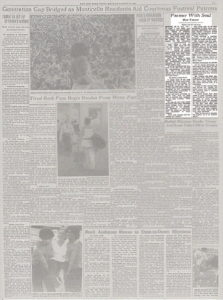
Appearing on stage on Woodstock’s second day, Yasgur received a hearty response when he addressed the crowd. Max’s reasons were both monetary and idealistic. He was paid a reported amount of $75,000, though many other reports on the exact sum differ. He was a pro-Vietnam War political conservative who firmly believed in the right of free expression. He once remarked to the New York Times that, “If the generation gap is to be closed, we older people have to do more than we have done.” His neighbours gave him the cold shoulder, others threatened him with arson, boycott of his dairy products, and physical attack. His wife, Miriam Yasgur, recalled how, after her husband saw this sign “Don’t buy Yasgur’s milk” she knew darned well he was going to let them have their festival.
Max Yasgur refused to rent out his farm for a next year’s (1970) revival of the festival, saying, “I’m going back to running a dairy farm.” In fact, Yasgur, suffered a series of heart attacks before Woodstock, and sold his farm in 1971 and relocated to Florida, where he died of a heart attack in 1973. Rolling Stone then paid tribute to him with a full-page obituary — a rare gesture for a non-musician. In 1984, at the original festival site, land owners Louis Nicky and June Gelish put up a monument marker with plaques called “Peace and Music” by a local sculptor from nearby Bloomingburg, Wayne C. Saward.
Legal Suits:
The owners of the adjacent farm sued Yasgur for $35,000, charging that large numbers of concertgoers used their property as a site of shelter and defecation and left their property strewn with refuse. Indeed, the festival had been lacking in sanitary facilities. This deficiency, combined with heavy rains and a spirit of chaos by the “hippis” made a rancid mess. One local farmer claimed that his cows refused to give milk due to noise and disturbances. Even Yasgur’s own farm incurred damage, for which he ultimately received a $50,000 settlement from its organizers. The organizers also reached a settlement with the townspeople. Eventually, the community decided to hold a dinner event in Yasgur’s honor, just to show him that not everyone had turned on him. About 80 lawsuits were filed against Woodstock Ventures, primarily by farmers in the area. Later on, the movie Woodstock ((1970 Documentary) financed settlements and paid off the $1.4 million of debt (equivalent to $12.3 million today) Roberts and Rosenman had incurred from the festival.
Sound:
Sound was engineered by Bill Hanley. “It worked very well”, he said. “I built special speaker columns on the hills and had 16 loudspeaker arrays in a square platform going up to the hill on 70-foot towers. We finally set it up for 150,000 to 200,000 people.” For many years this system was collectively referred to as the Woodstock Bins.
Light:
It was engineered by lighting designer and technical director E.H. Beresford “Chip” Monck, who was hired for 10 weeks of work for which he was paid $7,000 (equivalent to $61,000 today). But his plan was curtailed as the stage roof that was constructed in the shorter time available was not able to support the lighting that had been rented. The only light on the stage was from spotlights.
1970 Documentary: Woodstock (film):
Though Woodstock had left its promoters nearly bankrupt, their ownership of the film and recording rights compensated more than the losses after the release of a hit documentary film in 1970. And the film Woodstock became an Academy Award-winning documentary film, directed by Michael Wadleigh. One captivating aspect of Woodstock was a film interview with the gentleman who cleaned the portable toilets. This 3-minute dialogue portrayed, unexpectedly and in unusual fashion, Woodstock’s sociological complexities.
Earlier Artie Kornfeld (one of the promoters of the festival) went to Fred Weintraub, an executive at Warner Bros., and asked for funds to film the festival. Weintraub offered Kornfeld $100,000 (equivalent to $880,000 today) to make the film. And that helped to save Warner Bros. when the company was on the verge of going out of business. Wadleigh rounded up about 100 crew with no money to pay them, he agreed to a double-or-nothing scheme, in which the crew would receive double pay if the film succeeded and nothing if it bombed. However, it was a major hit for Crosby, Stills, Nash & Young and Matthews Southern Comfort. Woodstock received the Academy Award for Documentary Feature. Then Woodstock events were planned for anniversaries, the 10th, 20th, 25th, 30th, 40th, and 50th. In 1996, the film was inducted into the Library of Congress National Film Registry. In 1994, Woodstock: The Director’s Cut was released and expanded to include Janis Joplin as well as additional performances by Jefferson Airplane, Jimi Hendrix, and Canned Heat not seen in the original version of the film.
Woodstock Site Today, a Museum at Bethel Woods:
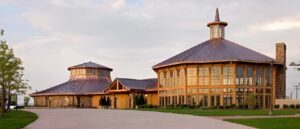
After cable television pioneer Alan Gerry purchased the site in 1996, the field and stage area remain preserved and are open to visitors as part of the Bethel Woods Center for the Arts It was inaugurated on July 1, 2006, with a performance by the New York Philharmonic on a newly constructed pavilion stage located about 500 yards (460 m) off the site of the 1969 stage. (The site of the original stage is vacant except for a commemorative plaque which was placed in 1984.) In June 2008 the Bethel Woods Center opened a museum dedicated to the experience and cultural significance of the Woodstock festival. The Museum is now the home to a permanent exhibit that features interpretive text panels, 20 different videos, over 300 photographs and 164 artifacts. With its 6728 square feet, the museum is divided into various sections that examine the 1960s and the festival.
Local Economic Impact:
Woodstock still acts as an economic engine for the local economy. A Bethel Woods report from 2018 indicates that 2.9 million visitors since 2006 and 214,405 visitors in 2018, an equivalent of 172 full-time jobs exist as a result, which includes direct wages of $5.1 million from Bethel Woods in Sullivan County
References:
https://www.woodstock.com/lineup/
https://en.wikipedia.org/wiki/Woodstock
https://www.britannica.com/biography/Max-Yasgur
https://www.nytimes.com/1969/08/18/archives/farmer-with-soul-max-yasgur.html
https://time.com/collections/woodstock50/5648246/woodstock-bert-sommer/
https://americanhistory.si.edu/explore/stories/remembering-woodstock
https://www.bethelwoodscenter.org/news/detail/santana-50-years-of-peace-music
https://time.com/collections/woodstock50/5645555/woodstock-max-yasgur/
******






I heard about Concert for Bangladesh, but never of Woodstock. In recent past, I have heard Coldplay and thought nothing can beat them.
My God, 400000 audience (even if a little below, does not matter), in a 3day open air concert, and Pandit Ravi Shankar and Alla Rakha are performing in the rain? I can’t believe it.
Great organization, not a single case of tragedy though there was enough reasons that the festival might collapse. Organisers and volunteers deserve millions of credits.
Good article, worth reading and lots of unknown to know.
Nicely written.
The event was unthinkable during those days, with no logistics services in place. It had certainly a great risk for the organisers, there was enough possibilities for a human disaster.
They deserve millions of credits, and for the audience and volunteers too.
It’s a eye opener article for me, I was not aware of it.
Thanks author.
পপ মিউজিক আমার বিষয় নয়, আমি খুব একটা জানিও না। কৌতূহলের বশেই পড়লাম।
অবাক করা আয়োজন। ইংরেজিতে কথা আছে, crazy people. নইলে তিনদিন ধরে এরকম কিছু করা যায়?
উদ্যোক্তাদের উদ্যমকে প্রশংসা করি।
এই লেখাটা না পড়লে জানতেই পারতাম না যে এরকম একটা অনুষ্ঠান হয়েছিল।
লেখাটা পড়ে ভালোও লাগলো
৬০ এর দশকে খোলা আকাশের নীচে মিউজিক নাইট বেশ প্রচলিত ছিল, শুধুমাত্র ইউরোপ বা আমেরিকায় নয়, এমনকি আমাদের দেশেও। কলকাতায় শীতকালে রাস্তা বা মাঠে ত্রিপল খাটিয়ে সারা রাত রীতিমতো জলসা হতো।
তারপর যুগের পরিবর্তনে এই জলসারও
অনেক নতুন নতুন সিস্টেম চালু হলো। এখনের cold play তারই পরিণতি।
তবে হোক না, বিদেশী নামী গ্রুপের কনসার্ট আমাদের দেশে হলে ভালোই তো।
Woodstock was not a huge profit making effort, (though they could make good money from the movie). On contrary from Osibisa to recent Cold Play, these were profit making plans. But if a Western pop group’s tour can generate 600 Cr. of Rupees for the Indian government, as tax, then why not?
I didn’t watch the event, but aware of the interest or craze, whatever you say.
From early Greek and Roman days to recent Cold Play, it’s a beautiful presentation of the changes, in precise.
Thanks
Woodstock was a milestone event, only the challengers can dream. If you ask me, the introduction by an Indian Guru, and Ravi Shankar ji and Alla Rakha ji performing in the rain is beyond my imagination. Carlos Santana, and his rhythm band was a sensation.
There were many such open air concerts afterwards, but was mostly limited to few thousands of audiences.
I was not an witness of Woodstock, could see later only in the movie. And that’s something you can not forget.
Woodstock is one such music event that music lovers would remember even if they were not in the audience. Not just because of its unexpected grand scale, I think many people got emotional attachment with it. As the author rightly mentioned, a most unknown milk dairy at a village remote place is now preserved as National Heritage site, with a monument and a museum. I was not knowing it.
Woodstock will remain in the heart of millions of the world.
উডস্টক একটাই হয়েছে, এর দ্বিতীয় সংস্করণ সম্ভব নয়।
Honestly, I don’t have mastery on western musics. Neither I have ever heard the name Woodstock. Just with some curiosity I have gone through the words, and now spellbound.
What an amazing event?
Even without knowing what’s happening in western musics around us, I can comment that any second Woodstock is not possible
Probably it was once for ever.
Author Asim Deb has sketched the words beautifully. Thanks.
কলেজে পড়ার সময় যারা খুব ইংরেজি সিনেমা দেখত আর ইংরেজি পপ গানের ফ্যান ছিল, তাঁদের মুখে অনেকবার এই উডস্টক উডস্টক বলতে শুনেছি। পপ গানের ফ্যান আমি কোনোদিনই ছিলাম না, কিন্তু পাল্লায় পড়ে পরে উডস্টক দ্যা মুভি দেখে আমি অবাক হয়ে গিয়েছি। তিনদিন ধরে খোলা মাঠের মধ্যে তিন লাখ লোকের একটা অনুষ্ঠান? গানের প্রতি বিদেশে কি উন্মাদনা সেদিন বুঝেছি। সেই সিনেমা দেখতে দেখতে আমিও যেন উডস্টকের মাঠে পৌঁছে গিয়েছিলাম।
আজ আবার অনেকদিন বাদে সেই উডস্টক উডস্টক মনে পড়ে গেলো।
অসীমের লেখাটাও সত্যি খুব ভালো লাগলো। অপূর্ব। 👌❤️🌹
Such a big event is not easy to manage. It had multiple aspects, to be considered and addressed meticulously, to avoid unwanted happenings.
Going through the article, one can understand what difficulties, organisers had to face.
Hats off to the performers and audiences, who came, participated and made it a gala event to commemorate.
Hats off to Ashimda too, for taking pain to collect every small and big information and present, before us.
সারা বিশ্বের সঙ্গীতপ্রেমীরা, বিশেষত যারা পাশ্চাত্য পপ গান শোনেন বা খোঁজখবর রাখেন, তারা উডস্টক নিশ্চয়ই মনে রাখবেন। আমার মনে হয়, কেবল এর বিশাল আয়োজনের কারণেই নয়, বরং এই নামের সাথে এক আবেগ তৈরি হয়েছিল। বিশ্বজুড়ে লক্ষ লক্ষ মানুষের মনে উডস্টক চিরকাল বেঁচে থাকবে।
লেখক সঠিক উল্লেখ করেছেন, প্রত্যন্ত গ্রামের এক অতি সাধারণ দুগ্ধ খামার আজ একটি স্মৃতিস্তম্ভ ও মিউজিয়ামসহ ‘national heritage site’ এর স্বীকৃতি পেয়েছে ও সেভাবেই সংরক্ষিত।
সঙ্গীত জগতে উডস্টক একটি মাইলস্টোন হয়ে থাকবে।
The Woodstock was a watershed moment in the 1960s counterculture movement. Expecting 50,000 attendees for a three-day music concert, the event instead drew, in my reading, an estimated 500,000, though official says it was 400,000.
The event, designed and billed as “Three Days of Peace and Music,” looms as large in the cultural imagination as the Apollo 11 moon landing that had captivated the world just a month earlier. But often lost in the haze of 1960s nostalgia is the fact that Woodstock, while undoubtedly a once-a-century cultural happening, was also a traffic-snarled, rain-soaked, memory.
There were lot of music festivals in the late 60s: Denver Pop Festival, Atlanta Pop Festival, Seattle Pop Festival, Atlantic City Pop Festival, the Texas International Pop Festival, and many others all took place during the same time, and all were much publicised.
The Isle of Wight Festival marked Bob Dylan’s first live performance since 1966, so it was highly anticipated, Rolling Stones appeared in Altamont. The Toronto Rock & Roll Revival, had the first truly live performance by a Beatles since 1966, and John Lennon & The Plastic Ono Band released their set as a live album (Live Peace In Toronto).
Still, they all pale in comparison to the fame of Woodstock. People around the world still has the craze to remember Woodstock, and not so for others
I am not a pop music fan, and was not aware of Woodstock. I just, with some curiosity gone through this texts. and now I wonder, what an event it was!!!
Defying organizers’ all the expectations, three hundred thousand people turned up instead of the anticipated fifty thousand; the surging crowd could not be contained, and half of them climbed over the fences to enter without tickets. Challenges regarding food, drinking water, medical care, rain, and transportation had to be tackled — yet the entire event proceeded peacefully. There were no incidents of violence. Even local residents who were the dissatisfied angry local people stepped forward to provide food and water. Probably they considered the visitors as their guests for three days, and a remarkable atmosphere of cooperation emerged during those three days.
Contrary to conventional belief, not everyone present was a drug user; the number of such individuals was negligible. The character of the young people who attended Woodstock was vastly different from the prevailing stereotypes.
Woodstock stands as a memorable and groundbreaking event in the context of American musical and cultural history.
In a capitalist country, such event is supposed to be money-making, anticipating to be disciplined with good music, and of course with the side effects of drugs. It was raining and overcrowded people stuck in the mud, even the performers had trouble to reach the venue. to even get on the stage. Overcoming the nature’s rain and organisational obstacles including supply of food, water, sanitation, transport, ….. the Woodstock festival went on, and made its place in history, and heritage as well.
Nobody, later could host such an event. Neither there would be any such event in the future.
Woodstock was one and the only one.
বিদেশে এই ধরণের খোলা মাঠের নীচে নামী দামী শিল্পীদের অনুষ্ঠানগুলিতে সুনামের যেমন খবর থাকে, খোলাখুলি সেক্স আর ড্রাগ চলে সমানতালে। নেল ডায়মন্ডের হট অগাস্ট নাইট শুনে আমি ওনার ফ্যান হয়ে গিয়েছিলাম।
উডস্টক উৎসবে পরিস্থিতি ছিল একেবারেই অন্যরকম। প্রোগ্রামে বিঘ্ন ঘটার সবরকম উপাদান মজুত ছিল, প্রকৃতিও বাদ সেধেছিলেন, অর্থাৎ বৃষ্টি, আর প্রচুর সাংগঠনিক বাধা সত্ত্বেও উডস্টক উৎসব ইতিহাসে নিজের জায়গা করে নেয় এবং একটি মিউজিক ফেস্টিভ্যাল হেরিটেজ তকমা পায়, এরকম দ্বিতীয় উদাহরণ নেই। পরে ১৯৭৩ সালে Watkins Glen দাবী করেছিল যে ৬ লাখ লোকের সমাবেশ হয়েছিল, কিন্তু প্রামাণ্য তথ্য নেই।
যাই হোক, উডস্টক ছিল অনন্য, অদ্বিতীয়। এমন আয়োজন ও হেরিটেজ স্বীকৃতি ভবিষ্যতে আবার হবে, প্রশ্ন চিহ্ন থেকে যায়।