
 Asim Deb
FIFA World Cups: The Science of Soccer Balls.
Compiled by Asim Deb.
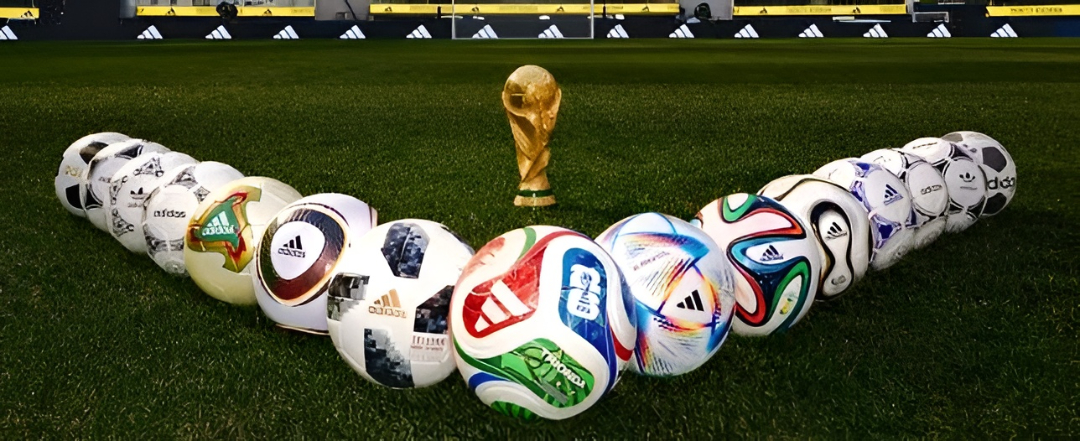
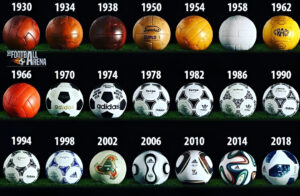
The FIFA World Cup™ has been the pinnacle of global soccer since its first match was played in 1930. In the early years, each host nation supplied their own match ball, resulting in major inconsistencies with other nations in quality and performance. Subsequently FIFA and every host nations realised that the quality of ball should improve using science and technology, and that is a continuous process FIFA is monitoring it for the last 96 years.
Initially, there were leather balls with an internal bladder inflated by a pump, with its open mouth hole secured by cotton laces. Then the first ball without lace came in the 1950 World Cup; air was pumped into the bladder through a valve, eliminating the need to tie the mouth hole with laces. This marked the beginning of the application of science and technology— and later days to improve issues like the weight of leather balls, speed loss due to friction with the grass, bounce and rebound distance, aerodynamic stability in flight, and preventing the ball from becoming heavy by absorbing water on wet pitches or during rain.
Stitched leather balls gave way to adhesive-bonded textured panels, followed by the more modern thermal bonding technology. While the ball’s chemical characteristics and electronic applications have undergone significant changes, its physical shape has remained largely the same. A football in the FIFA World Cup should weigh between 410 and 450 grams (14 to 16 ounces) at the start of the match. The standard size of ball is no. 5, that must have a circumference between 68 and 70 centimeters and be inflated to a pressure of 0.6 to 1.1 atmospheres at the sea level. Modern balls now have a sensor that assists referees and the VAR team via TV panels during contentious on-field decisions.
Until 1966, the footballs used in the FIFA World Cup were primarily made of leather. The first major shift came in 1970 when FIFA entrusted Adidas with the responsibility of supplying the tournament’s match balls. This marked the beginning of a practice where the design, manufacturing and naming of the ball for each FIFA World Cup tournament were determined based on specific criteria. Changes also made in the ball’s looks and cosmetic aesthetics, as host nations began introducing themed designs to showcase their civilization and culture. Colored balls were introduced in 2002 to ensure clear visibility even from a distance. Thus, over the past 96 years, the ball has evolved through various changes in its appearance, technology, and manufacturing process.
2026 FIFA World Cup: TRIONDA
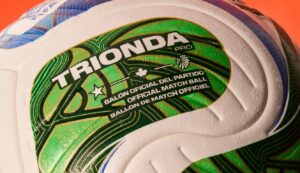
In Spanish, the word ‘TRIONDA’ means “Three Waves,” signifying that for the first time 3 countries are jointly hosting the FIFA World Cup: Canada, Mexico, and the United States. The ball’s design features three colors – red, green, and blue, paying tribute to the 3 host nations, with symbolic representation of a maple leaf for Canada, an eagle for Mexico, and a star for the United States, while gold-colored detailing honors the FIFA World Cup trophy.
Sophisticated technology:
Design of TRIONDA ball overcomes air resistance (drag) while in flight, maintaining stability in the air. Additionally, embossed icons visible only from close range ensure a secure grip and control during shots or dribbling, both in wet or humid conditions. It also incorporates ‘Connected Ball’ technology featuring a 500Hz motion sensor chip, that transmits precise, real-time data on every movement of the ball to the Video Assistant Referee (VAR) system, assisting match officials in making decisions on the pitch, particularly in complex situations like offside calls.
2022 Qatar FIFA World Cup: Al Rihla
In Arabic, the name means ‘The Journey’. Its design is a symbolic inspiration of the host nation Qatar’s culture, architectural style, traditional boats, and national flag. ‘Al Rihla’, manufactured by Adidas, was the fastest ball in World Cup history. With ‘Connected Ball’ technology, that could assist match officials in making quick and accurate decisions during on-field disputes. It also features a ‘CRT-core’ that ensures speed and consistency, along with a 20-panel ‘Speed shell’ polyurethane cover designed to enhance accuracy, aerodynamic stability, and swerve capabilities.

Apart from the official match ball of the 2022 FIFA World Cup, for the semi-finals and final, Adidas released Al Hilm – meaning ‘the dream’ with a textured gold base colour and subtle triangular pattern, drawing inspiration from the deserts that surround Doha, the colour of the World Cup trophy, and the pattern of the Qatar flag.
2018 Russia FIFA World Cup: Telstar 18
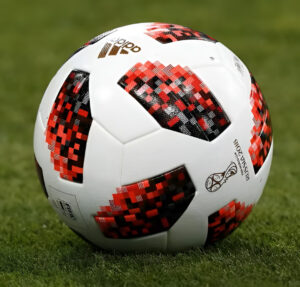
The Telstar 18 ball featured a NFC (Near-Field Communication) chip, allowing spectators to interact with the ball using their smartphones. While the Telstar 18 was used during the group stage, the red-colored ‘Telstar Mechta’ was used in the knockout stage. In Russian, the word ‘Mechta’ means ‘dream’ or ‘aspiration’. Made from six textured panels seamlessly bonded with adhesive instead of stitching, the ‘Telstar 18’ ball ensured a highly precise and accurate trajectory, alongside a smooth surface and low water absorption.
2014 Brazil FIFA World Cup: Brazuca
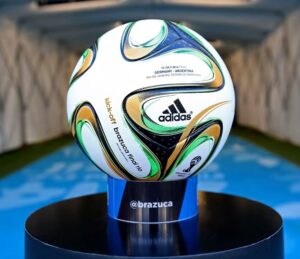
Taipei-based company Long Way Enterprise were given contract to manufacture the ball in their subsidiary YaYork Plastic Products in Shenzhen, Guangdong province, China. The company has been associated with production of Adidas balls since 1997. However, the Long Way Enterprise was unable to meet the high demand for the ball. Then the Forward Sports (based in Sialkot, Pakistan), was awarded the contract. Forward Sports was associated with Adidas since 1995 and already supplied footballs for the UEFA Champions League and the German Bundesliga.
The Brazuca ball went through a more rigorous testing process than any other World Cup ball before it, with over 600 professional footballers, 30 teams of scientists and the obligatory laboratory tests putting it through its paces. With six identical propeller-shaped panels, the Brazuca’s surface structure and symmetry were designed to provide improved aerodynamic quality, stability, touch and grip.
Over one million people voted for the name of the ball, with Brazuca emerging as the top choice, a term used by Brazilians to express pride in their way of life. The coloured and swirling lines on the panels represent traditional Brazilian wish bracelets. Just like the two previous tournaments, adidas created a special edition with gold curved lines for the final: the Brazuca Final Rio.
2010 South Africa FIFA World Cup: Jabulani
In the Zulu language, ‘Jabulani’ means ‘to celebrate’. The ball’s 11 distinct colors represent the number of players on a football team, South Africa’s 11 recognized official languages (excluding English), and the nine host cities selected for the first World Cup held in Africa.
The balls were made in China, using latex bladders supplied by Enkay Rubber Group, India, thermoplastic polyurethane elastomer supplied from Taiwan, and ethylene vinyl acetate, isotropic polyester / cotton fabric, glue and ink from China. Made of eight thermally bonded 3D panels and moulded into a perfect sphere, the Jabulani boasted a ‘grip ‘n groove’ texture which was designed to enable perfect grip and maximum control in every conditions.
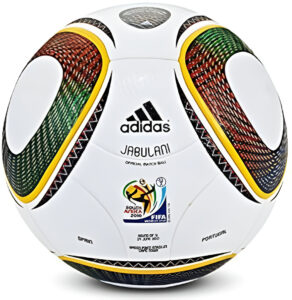
The official match ball for the final was a special gold edition called the Jo’bulani, named after the final venue in the host country, Johannesburg.
2006 Germany FIFA World Cup: Teamgeist
Teamgeist – meaning team spirit – was significant with its new production process meaning it was less than even one percent short of being a perfect sphere. The ‘Adidas +Teamgeist’ ball was produced with a joint venture of Adidas and the Molten Corporation. The ‘plus’ (+) sign was added to its name primarily for trademark purposes, because the German word ‘Teamgeist’ (meaning ‘team spirit’) could not be trademarked as a generic term.
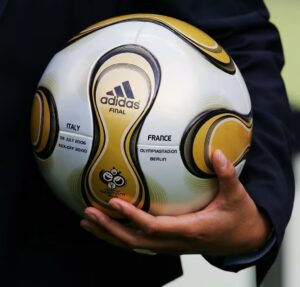
For the final match, Adidas produced a special gold edition of the ball named ‘Teamgeist Berlin’. For the first time in World Cup history, the names of the two competing teams, the stadium, the city, the date, and the kick-off time were inscribed on each ball. The black and white colors of the ‘Teamgeist’ paid tribute to the traditional colors of the host nation, Germany, while its gold accents established a visual similar to the World Cup trophy. Leaving behind the hexagonal and pentagonal panels of the previous eight tournaments, the Teamgeist had 14 panels designed to resemble propellers which were thermally bonded, rather than being stitched together.
2002 Korea / Japan FIFA World Cup: Fevernova
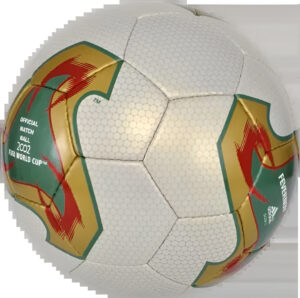
The hand-stitched Fevernova’s name came from a combination of the words ‘fever’ and ‘supernova’. The four trigons which adorned the ball were a representation of wind turbines, in a celebration of alternative energy sources.
The 2002 World Cup marked a break from traditions as the triads of the previous six balls were replaced with four trigonal designs, although the familiar hexagonal and pentagonal panels remained. The ball was composed of 11 layers and was 3-mm thick, including a special foam layer with gas filled balloon imbedded in a syntactic form. The outer cover was made from a combination of polyurethane and rubber. It gave an improved layer of syntactic foam that provided extra cushioning for greater control and accuracy.
1998 France FIFA World Cup: Tricolore
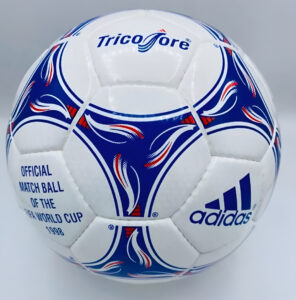
It was Adidas’s first multi-coloured offer for the tournament and the first to feature syntactic foam. More than twenty roughs were proposed by the Adidas design team with the aim to amalgamate symbols of the French culture and heritage, adopting the colors used in the French Revolution. The Gallic rooster and the TGV. The triads on the Tricolore were in blue, white and red, with the name a reference to France’s national flag bearing the same colours. Each triad featured three cockerels, a French national symbol, with the red comb representing the adidas logo.
The syntactic foam layer that coated the Tricolore was made from gas-filled durable micro-balls, which were an addition to increase the ball’s speed and ‘energy return’, and are still used in balls to this day.
1994 USA FIFA World Cup: Questra
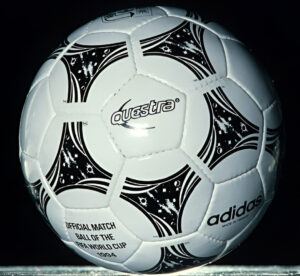
Questra’s triads were decorated with planets, stars and rockets.
Adidas followed the production process which would be familiar to fans of the global game from 1970 until 2002, with 12 pentagonal and 20 hexagonal panels.
1990 Italy FIFA World Cup: Etrusco Unico
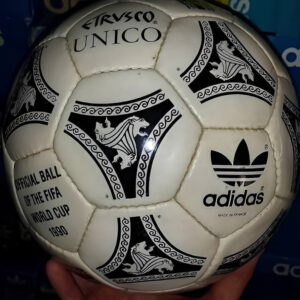
The ball was named with reference to the Etruscan people, who lived in central and northern Italy from around 800 to 100 BC, the Etrusco Unico. Each of the triads on the ball was adorned with the heads of three lions, each with their mouths open. This was a common design in Etruscan culture, found on many stone sculptures and adornments.
Manufactured by Adidas, the Etrusco Unico was highly notable for being the first World Cup ball to feature an internal layer of black polyurethane foam for total waterproofing and faster speed.
1986 Mexico FIFA World Cup: Azteca
Named in reference to the Aztecs, who lived in the region between the 14th and 16th centuries, the Azteca followed the format of the Tango Durlast and Tango España. The design of the triads changed slightly, with the architecture and murals of the Aztec people and host country Mexico. Manufactured by Adidas, Azteca was the first that was made entirely from synthetic material, ensuring that absorption of water was minimised and making the France-manufactured ball more durable.
1982 Spain FIFA World Cup: Tango España
Following on from the successful design footprint of four years earlier, adidas made some slight modifications for the renamed Tango España.
Again featuring 20 black triads on hexagonal panels, with each triangle combining to form 12 circles, the Tango España moved away from the Durlast coating of the 1970s and was instead covered in polyurethane, with an extra layer for the seams. 30 years on from the tournament in Spain, the official ball for UEFA EURO 2012 in Poland and Ukraine was named the Tango 12 to honour the earlier trailblazer.
1978 Argentina FIFA World Cup: Tango Durlast
Named after the world-famous dance which has its origins in 19th century Argentina, the Tango introduced an eye-catching curved triads to a global audience, a design milestone which was replicated in the five World Cups which followed. Made in France and hand-stitched, the Tango boasted the Durlast waterproof coating which had featured on the 1970 and 1974 Telstar balls.
1974 West Germany FIFA World Cup: Telstar Durlast
Following the iconic design template of its predecessor, both the 1970 and 1974 Telstar balls had a Durlast plastic coating, making the ball resistant to water and mud, with the latter adding that element to its name. Adidas supplied two balls: the white Chile Durlast, which was ideal for floodlit matches, and the orange Apollo Durlast, for better visibility in snow, with only the white Chile version needed.
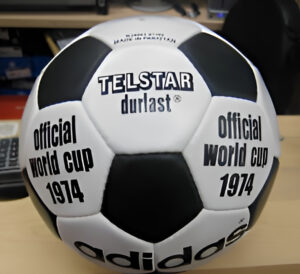
In a change from the previous two World Cups, the matches were played with branded balls, showing the name of the ball, manufacturer, and the words ‘Official World Cup 1974’.
1970 Mexico FIFA World Cup: Telstar
The 1970 World Cup marked a history with Adidas appointed as the official ball supplier – a partnership which still continues to this day. Founded by former West Germany kit manager Adi Dassler, Adidas’ first offer was the iconic Telstar with 32 panels – 12 black pentagons and 20 white hexagons – a design regularly used to represent footballs all around the world. Also available in orange and white, the balls used for matches in North America did not feature the Telstar name or the adidas logo.
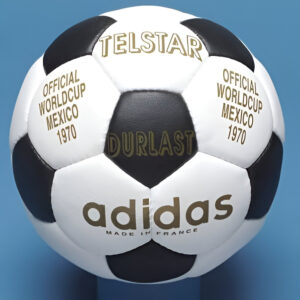
The ball was named after the communication satellite that made the first live international TV transmissions.
1966 England FIFA World Cup: Challenge 4-Star
Prior to the 1966 tournament, over 100 unbranded balls were submitted to the English Football Association, where a group of experts tested the shape, circumference, roundness, weight, loss of pressure and rebound distance of each.
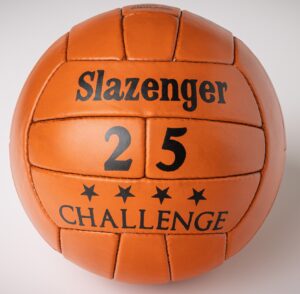
Manufactured by the British firm Slazenger, famed for their tennis and golf equipment, the Challenge 4-Star emerged as the winner, with the 25-panel ball available in white, yellow and orange. The white version was used most frequently, but it is the orange ball which has become synonymous with the tournament after being used for the emotional final between England and West Germany, when the host nation secured a victory during extra time.
1962 Chile FIFA World Cup: Mr. Crack
Manufactured using 18 strips of leather, Mr. Crack had rounder panels than its predecessors, which made it appear more spherical. It was also the first World Cup ball with a latex valve, which ensured it retained its shape for longer as air could escape only slowly. When Adidas began making footballs in 1963, one of their first balls was named the Santiago as a tribute to the tournament ball and was based on the design of Mr Crack. There were some technical issues with water absorption for Mr Crack, with several European teams preferring to use alternative balls.
1958 Sweden FIFA World Cup: Top Star
A competition was arranged by FIFA to select the official World Cup ball from 102 unbranded footballs. With the names of the manufacturers in sealed and numbered envelopes to be opened during the World Cup draw, the eventual winner was the Top Star – which was available in yellow, light brown and white. The white ball – featuring 24 leather strips and coated in wax to keep out moisture was used for most of the matches, including during the final of Brazil vs. Sweden.
1954 Switzerland FIFA World Cup: Swiss World Champion
Made from greased leather, the Swiss World Champion retained a slightly yellow colour, which made it easier for supporters to see than previous dark brown footballs. This characteristic was particularly helpful during the rainy and muddy conditions of the 1954 final. With waterproof leather balls not available until the 1980s, the Swiss World Champion absorbed some water and became increasingly heavy during the final in Berne.
1950 Brazil FIFA World Cup: Superball Duplo T
Despite carrying the words ‘Industria Brasileira’, the Superball Duplo T was originally patented by Argentina-based company Tossolini, Valbonesi, Polo & Cia, who had named it Superval Doble T. But with the manufacturers opening a branch in Brazil after the Second World War, they became the official suppliers of the World Cup ball, which was reimagined as the Superball Duplo T after some minor changes.
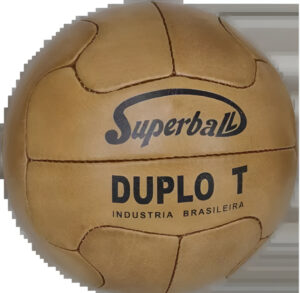
It was the first World Cup ball without laces, and was inflated via a valve inserted directly into one of the 12 identical hand-stitched strips of leather, providing a more uniform, round and sealed surface. The rounded edges of the lighter panels provided more durability and stability as the stitching was offered extra protection.
1938 France FIFA World Cup: Allen
As with all official World Cup balls to feature between 1934 and 1966, Allen was made by a French manufacturer named Allen in the host country. It was the first World Cup ball to carry its manufacturer’s name, as the brand Allen was visibly printed on the surface of the ball itself.
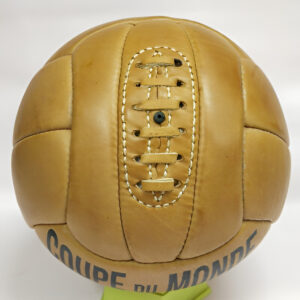
The ball featured 13 leather panels and was stitched together using cotton threads and laces. Carrying a similar design to the Federale 102 with 13 panels and cotton threads, the Allen was another World Cup ball with an Olympic past, having been used at the 1924 Paris Games.
1934 Italy FIFA World Cup: Federale 102
The Federale 102 match ball was manufactured by ECAS (Ente Centrale Approvvigionamento Sportivi), the Italian government’s sports supply company. While ECAS provided the primary Federale 102, it was not the only ball used during the tournament. According to FIFA, teams also utilized the Globe and the Zig-Zag balls, both of which were produced by British manufacturers FIFA. Consisting of 13 hand-stitched leather panels, the incision for the bladder on the Federale 102 was stitched with cotton threads, rather than leather, to make heading the ball more comfortable.
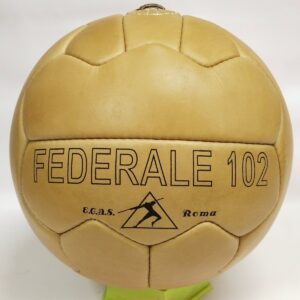
The other balls to feature were the Globe and the Zig-Zag, both of which were produced by British companies. The William Sykes-manufactured Zig-Zag – made in a similar style to the 1930 T-Model – was selected for the final, which hosts Italy won 2-1 after extra time against Czechoslovakia.
1930 Uruguay FIFA World Cup: T-model
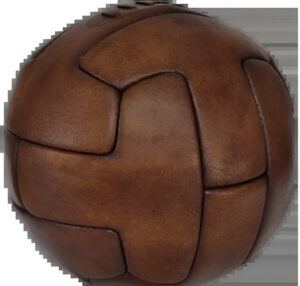
There was no specific ‘official match ball’ for the first FIFA World Cup held in Uruguay in 1930. At that time, two types of handmade leather balls—the ‘Tiento’ and the ‘T-Model’—were used. For the Uruguay–Argentina final, the host nation, Uruguay, wanted to play with their own ‘T-Model’ ball, while the Argentine team had the ‘Tiento’ ball. To resolve this impasse, FIFA referee John Langenus decided that the match would be played with Argentina’s ‘Tiento’ ball in the first half and Uruguay’s ‘T-Model’ ball in the second. The impact of this decision was dramatic; although Argentina led 2–1 in the first half using their own ball, Uruguay triumphed 4–2 in the second half playing with theirs. According to the BBC, the match led to the birth of the famous phrase in football – ‘A Tale of Two Halves’.
Having been used at the Paris 1924 and Amsterdam 1928 Olympic Games, the T-model was regarded as a reliable option. Named after its eleven T-shaped strips of hand-stitched leather, the T-model was used for some, but not all, of the matches at the very first World Cup.
The T-model ball was manufactured by the English sporting goods company John Salter & Son, which had been imported into Uruguay by the Montevideo-based distributors Clericetti & Barrela. This historic cowhide leather ball, named after its eleven T-shaped hand-stitched strips, featured thick leather laces used to seal the inner bladder.
References:
https://www.fifa.com/en/tournaments/mens/worldcup/canadamexicousa2026/official-match-ball
https://www.fifa.com/en/tournaments/mens/worldcup/canadamexicousa2026/articles/ball-balls-history
https://www.olympics.com/en/news/fifa-world-cup-ball
https://www.adidas.com/us/blog/the-complete-history-of-adidas-world-cup-match-balls
**********




Fantastic!
History of the ‘Football’ for Fifa World Cup can never be described better than this article.
Asim, you are at your marvelous analysis with perfection and timely presentation as usual.
Let the balls of different sizes and shapes keep on rolling in your arena satisfying all your readers tasted and likings.
An uncommon subject can become a so interesting tropic. This is a big example. We see the writer has made the soccer ball here to a very interesting phenomenon. He has nicely put forward the various changes of the soccer ball globally.
We can know the latest status of the ball although there is no physical change. Thanks to the writer.