
 Asim Deb
Cricket on Mount Everest, Mount Kilimanjaro?
Compiled by: Asim Deb
You want something different, may be to bring your name in the record book, or sometimes may be just for your fun. But making something different is not so easy. What you think “different” might not be so for the common men. So, making exception is not that easy. But there are always some crazy people who are willing to do something that others may not even think.
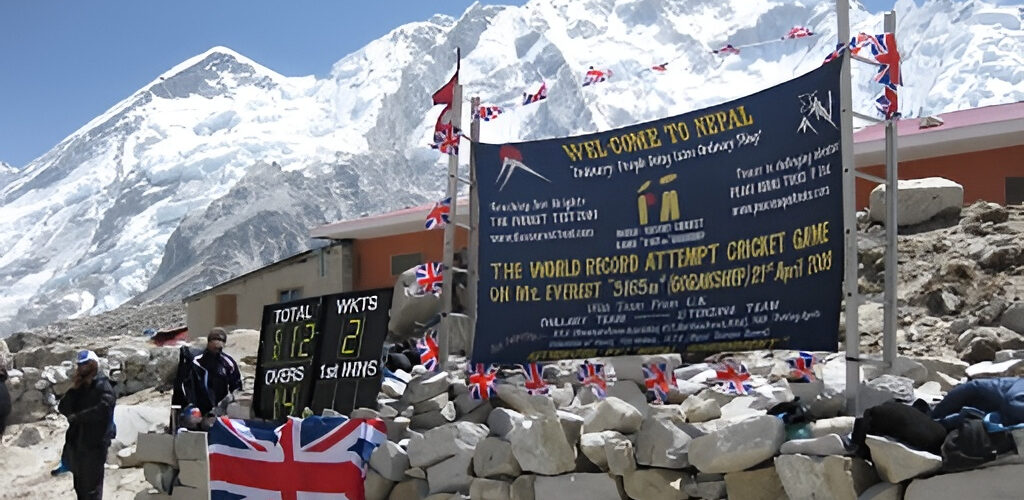
So, some people thought let’s play cricket on the mountain range. The Guinness Book of Records endorsed the idea, to mark the new record of the highest-altitude cricket match ever played, beating previous attempts by nearly 600 meters, to play an official cricket match at an altitude of 5,164m, approximately 17,000 feet on the lead up to Mount Everest (for academic interest, Mount Everest has an elevation of 8,848 meters, i.e. 29,031 feet above sea level).
ICC approved world’s highest international cricket stadium is the Himachal Pradesh Cricket Association (HPCA) Stadium in Dharamshala, India, at an altitude of 1,457 meters (4,780 feet). With another example, nestled amidst deodar forests in the quaint hill station of Chail in Himachal Pradesh, Chail Cricket Ground is the highest in the world, at an altitude of 2,444 metres above sea level and offers majestic vistas of the Sutlej Valley, Shimla and Kasauli. Built by the Maharaja of Patiala in 1893, this highest-altitude cricket ground is used by the children of the Chail Military School.
So cricket will now move to a higher altitude, by more the 14,000 feet, and that would be a new world record for the highest official team game ever to be played, as recognised by The Guinness Book of Records. At the same time, the event should show the path to overcome the physical and mental demands of altitude while also raising a fund of over £250,000 for charities, including The Lord’s Taverners.
The Lord’s Traverners is a UK youth cricket and disability sports charity. Its charitable objective is to empower young people facing challenges of inequality. It was founded in 1950, the week after the West Indies’ victory over England in the second Lord’s Test Match. The founders were inspired by watching cricket from the Lord’s Tavern pub in St John’s Wood Road, close to Lord’s Cricket ground. Initially, money raised each year was given to the National Playing Fields Association, on the recommendation of Prince Philip, the Duke of Edinburg, the patron and ‘Twelfth Man’ of the Lord’s Taverners.
Finally it was decided that a T20 cricket named “The Everest Test 2009” would be hosted on April 21, the birthday of Queen Elizabeth II, at 5,164 m (16,942 ft) above sea level at the Gorak Shep plateau, Nepal between two teams named Team Tenzing and Team Hillary.
The project was approved by the Nepal Ministry of Tourism and Civil Aviation with approval from the Youth and Sports Ministry, Home Ministry and Forest Ministry. However, the Warden of the National Park, Ram Chandra Kandel mentioned the rule that a foreigner require a permit to enter any national park in Nepal and also cited public pressure to stop the team in Monjo. So, few days before the match, on 12th April, when the British players arrived, they were left stranded after Sagarmatha National Park denied their entry for the cricket match at the Everest Base Camp. Nepal Minister for Forest Kiran Gurung had fly to Lukla to rescue the players and the event, that’s the Queen’s birthday.
The expedition required a massive logistical feat, including two tonnes of equipment and kit freighted to Kathmandu and then trekked up the mountain region to Gorak Shep. Concern was it required flawless planning and arrangements to protect the volunteer players from extreme weather and the intense altitude. The players were professionals with full-time jobs in the UK, and Hypoxia was a major concern that effects a person’s medical condition where your body, or a specific region of your body, does not receive enough oxygen to function properly at the tissue level. The person might collapse also.
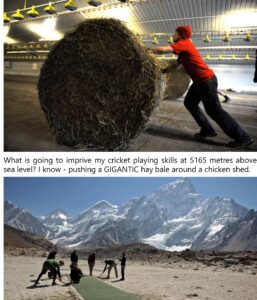
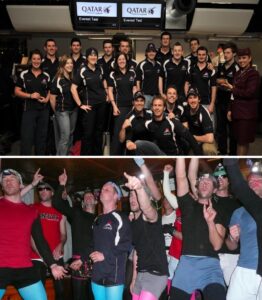
A 65mX45m ground was made in Gorakh Shep for the event. Four air-flights to Lukla airport carried the passengers, and also water, food, oxygen, satellite phones, cricket gear, photographic equipment, even the cricket pitch, and also the tents, toilets, food canteens, wine bar, and arrangements of weekend funs. 2 tonnes of kits and equipments were freighted to Kathmandu and then to Lukla, the gateway to the Everest region and to Gorak Shep, the original Everest Base Camp. Nokia and Qatar Airways sponsored this project. And Peace Nepal Treks escorted 50 people trekking to Gorak Shep including 2 full cricket teams with reserves, 3 ICC qualified umpires, 4 doctors and a team of ‘trektators’ who were an integral part of the fundraising events, training and organisation of the challenge.
The two year complex logistical project extended Victoria’s first experience of a major expedition, challenging starting point for her career, and her first foray into global projects of a grand scale. The Everest Test raised eyebrows of people around the globe, making front page news in several countries, it was followed by millions through TV news updates, and finally the expedition raised over £100,000 for charity.
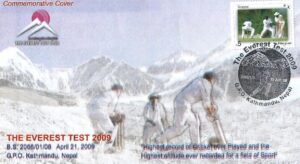
Nepal Philatelic Society issued a special cover on 21 Apr 2009 to mark THE EVEREST TEST 2009.
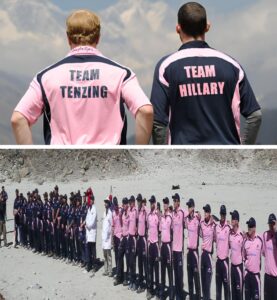
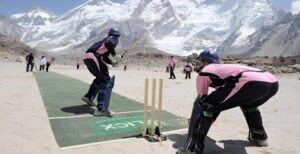
Finally, Team Hillary defeated Team Tenzing.
Now let me share some of the photographs, as writing texts would be difficult to narrate the diary of historical Everest Test 2009.
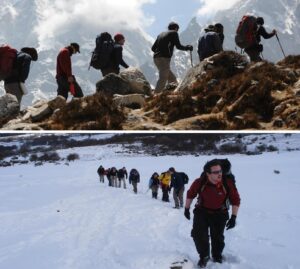
First, the journey to the base camp of cricket expedition. The players and also the other officials were escorted by a team of expert Sherpas. So, apart from cricketing experience, the players could also learn a basics of mountaineering, and body acclamation at the high altitudes.
Next, the arrangements for fun and leisure time.
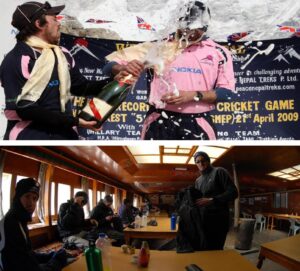
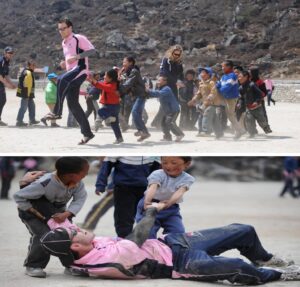
And some fun with the local kids also
**********
But records are never a constant.
The Everest Test 2009 in turn inspired “Mt. Kili Madness”, and interestingly, this time one of the two teams was captained by the England women’s vice-captain Heather Knight.
Apart from a record in the Guinness Book, this “Mt. Kili Madness” benefited three charities: Cancer Research UK, the Rwanda Cricket Stadium Foundation and Tusk, an African-based wildlife conservation charity, the event confirmed that £80,972 was raised. Richard Beghin, managing director, Flicx UK, which was providing the portable cricket pitch for the event, said: “I started Flicx at the back end of Apartheid – so as to assist in creating a level playing field for young white and black cricketers – where they could play a game of cricket without prejudice, racial barriers – but more importantly on skill and the passion to win.
Alan Curr, holder of the current world record game at Everest base camp – author of Cricket on Everest, and head of junior cricket in Japan, said: “Well there goes my best conversation starter…I guess I will have to look for a new mountain to play on! But seriously if I am going to lose the world record then at least the fantastic causes that Mt Kili Madness are supporting will benefit.”
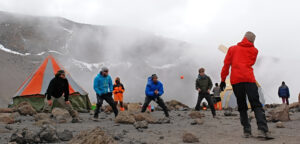
On September 26, 2014, an international group of cricketers played the highest-altitude cricket match ever on Reusch Crater on Mount Kilimanjaro, at 5,730 meters (18,799 feet) above sea level. Mount Kilimanjaro, the tallest mountain in Africa, stands at 5,895 m (19,341 ft.) above sea level. The flat crater in which the game took place was therefore only 143 m (470 ft.) below the peak of the mountain. The match would follow all the official ICC rules and conditions, including everything from cricket whites (with a few extra layers!) to an official scorer. The game was played on a plastic pitch rolled out over the ice, and a bright orange ball was used.
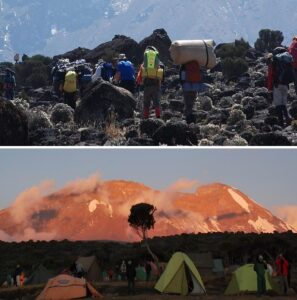
The match took place after a seven-day trek up the mountain, with the 25 players (including three sub fielders), qualified umpires, match adjudicator, porters, medics, press, independent witnesses and spectators battling altitude sickness and temperatures as low as -20C on the ascent. And because balls fly longer at such a high altitude, the organizers packed 24 additional balls.
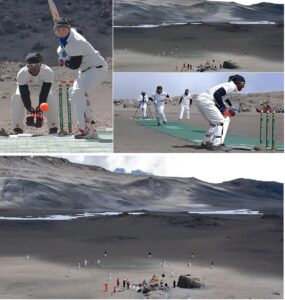
The T20 match was curtailed to 10 overs each before clouds stopped play. The match lasted for total of 88 minutes (Gorillas batted for 42 minutes from 9 a.m. to 9.42 a.m.; Rhinos batted for 38 minutes from 9.50 a.m. to 10.28 a.m.). The “Gorillas” team, led by England women’s vice-captain Heather Knight, scored 82-5 to beat Giles’ “Rhinos” team, who managed 64-9, thus the Gorillas team wins by 19 runs over the Rhinos. The teams included former South Africa fast bowler Makhaya Ntini and ex-England spinner Ashley Giles.
The thinness of oxygen at 5,752 m during the match meant that the ball travelled faster through the air, and this is likely to have had a bearing on the number of sixes (10) hit during the match – three of them from man-of-the-match Phil Walker. In contrast, only five fours were struck on the uneven terrain in the 20 overs of play that were possible.
At the end, the conclusion is that we can expect more such games at the mountains, with both female and male players are coming up, apart from fun, but for the noble cause of charity.
********







Add comment