
 Asim Deb
Sports and it’s Disasters
@Compiled by Asim Deb.
Throughout the history of sports, numerous hazards endangered the participants and often the spectators. Sometimes the victims survive, but often not. But still the demands from professional players are intolerable. Today’s greed of sports, the business and self interest for playing more tournaments at pressure has all but wiped the kind of grace from sport’s scene. The pressure on professional athletes across the globe whether playing for clubs or their countries—often spirals out of control, driven by the soaring ambitions of sports promoters, an insatiable greed for money, and the financial interests underlying the frequent organization of tournaments. Most of these promoters are businesspeople who hold the reins of club or national team management; in doing so, they often all but obliterate the traditional aesthetics and decorum of the sport.
Throughout the history of sports, numerous dangerous situations have arisen, such as a lack of restraint among participating athletes, serious injuries, tragic deaths, the absence of proper medical care during emergencies, unruly fans, stadium disasters, violence, and incidents like doping. In many instances, spectators have faced risks, while players and officials have been killed for political reasons. Some return and others do not, that is the reality. For example, Nari Contractor survived a life-threatening situation, whereas Raman Lamba of the Indian cricket team lost his life abroad on Bangladesh soil due to a similar incident.
Physical contact, or collision at high speed between players is an inevitable aspect of sports like football or basketball; the risk of broken bones or torn muscles are now accepted hazards. Athletes, often billionaires and millionaires, competing at the highest levels driven by the desire for a career, popularity, and immense wealth are well aware that their physical capabilities, stamina and endurance often cannot keep pace with the demands placed upon them. Yet, they continue to play despite the risks; often, even when they feel the need for medical attention, they ignore it or keep it hidden. Nowadays, significant risks are inherent in many sports such as football, basketball, cricket, car racing, boxing, and wrestling. For some athletes, physical pain or neglect can eventually lead to severe or even fatal consequences.
Incidents caused by the arrogance or interference of wealthy, or influential political person’s interference also makes the games darker. A case in point is the 1982 FIFA World Cup in Spain, where Kuwaiti Prince Sheikh Fahad Al-Ahmed Al-Jaber Al-Sabah personally stormed onto the ground to disrupt a match in protest against a goal scored by France; he claimed that his team’s defenders had hesitated after hearing the sound of a whistle from the stands. He even threatened to withdraw the team from the tournament, and surprisingly, the referee agreed to disallow the goal. Although no accidents or casualties occurred, the situation could certainly be described as a disaster of sorts.
Let me first mention a few incidents that took place on our Indian soil.
On January 1, 1967, during the second Test match of the series between India and the West Indies at Kolkata’s Eden Gardens, the local authorities (CAB) sold several thousand tickets in excess of the stadium’s capacity. When the overflow crowd climbed over the fences to enter the field and attempted to sit on the grass near the boundary, the police intervened to stop them. The incident, which began with protests by spectators, quickly escalated into arson, fire and widespread rioting within the stadium. Although there were no major reports of deaths or serious injuries, the potential for such outcomes was significant.
Subsequently, on December 16, 1969, during the fourth Test match of the series between India and Australia in Kolkata, approximately 25,000 spectators had been queuing outside the stadium since the previous night, hoping to purchase tickets for the fourth day’s play. Chaos erupted as soon as the ticket counters opened at 7 a.m., resulting in a tragic stampede outside the ground that left six people dead and around 100 seriously injured. But the match continued, as scheduled. So, a tragic disaster during the match does not mean that the game will be interrupted. The business, I mean the game would continue.
In one of the most infamous incidents in Indian football, Mohun Bagan lost the 1973 IFA Shield final against East Bengal at Eden Gardens due to controversial and poor officiating. Following the match, substitute player Sukalyan Ghosh Dastidar, who had been seated on the bench, punched the referee hard on the nose. Match official Biswanath Dutta suffered severe and permanent injury on his nose and eyes, an incident that ultimately brought his refereeing career to an end. This event encapsulates the nature of the fierce yet unrestrained volatile rivalry that characterized the competition at the time.
On August 16, 1980, during the Calcutta Football League derby match between East Bengal and Mohun Bagan at Eden Gardens, a physical altercation broke out between Mohun Bagan’s Bidesh Bose and East Bengal’s Dilip Palit, causing tension to spread to the galleries. More than 70,000 spectators had gathered at Eden Gardens to watch this crucial match, and the incident resulted to violent tensions among the supporters of both teams. Chaos ensued as many terrified spectators tried to flee in a hurry; consequently, 16 supporters from both teams lost their lives in a stampede within the stands, and over a hundred spectators were seriously injured.
On June 4, 2025, at the M. Chinnaswamy Stadium in Bengaluru, a massive and uncontrolled crowd gathered to cheer for Virat Kohli and the RCB team; a stampede ensued, resulting in the deaths of 11 fans and injuries to over 50 others.
Let me recount some incidents involving player facing serious injuries or unimaginable deaths that have occurred on Indian soil.
In the 1973–74 season, on the day of the Kolkata Derby against Mohun Bagan, East Bengal’s reliable defender Shyamal Ghosh sustained a head injury requiring several stitches. However, given the immense pressure on the team and the players as it was the Shield final, he took the field despite the stitches. During the match, he leapt to head away a ball floating into the penalty area; the stitches on his forehead tore open, yet such was the prestige of the match, he continued playing with a blood-soaked bandage. Another example involves Subhash Bhowmick, a footballer known for his robust physique; while chasing the ball during a match against Mohun Bagan, he lost his balance and inadvertently fell onto the thigh of Mohun Bagan defender Shankar Banerjee, leaving Shankar so severely injured that he was forced to bid farewell to football forever.
In the 1992–93 Indian National Football Championship, defender Sanjib Dutta lost his life while playing for Railways; he was struck forcefully in the chest by an opposing player’s elbow as he leapt into the air to contest the ball.
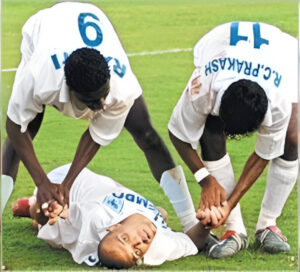
In the 2004 Federation Cup final, India’s highest-paid footballer at the time, 24-year-old Brazilian Cristiano Junior de Lima, had a horrific collision with Mohun Bagan goalkeeper Subrata Pal while scoring his second goal in the 78th minute of the match. Cristiano lost his balance and fell on the ground. Although the most important competition in Indian football (The Champion Team of India), and this was the final match, yet there were no emergency medical facilities available at the ground. Cristiano was rushed to the hospital in an unconscious state, where doctors declared him dead. A subsequent post-mortem examination revealed that Cristiano Junior had suffered a massive heart attack while playing on the field, which caused his death.
In 1962, India’s young captain Nari Contractor was critically injured after being struck on the head by a delivery from West Indies fast bowler Charlie Griffith. Although he made a remarkable recovery, he never returned to the sport.
Now, let’s look at some events outside India.
During 1970 FIFA World Cup against Italy, the German Franz Beckenbauer, then only 24 years old, had suffered a dislocated shoulder after a foul by Italy’s Pierluigi Cera in the 70th minute. Beckenbauer struggled with his right arm, with a broken collar bone dislocated at his shoulder. However that was a crucial match to reach the tournament final, so he simply wrapped up in a sling fixed to his body by tape and his hand below his heart, through the full rest 20 minutes of the game and then 30 minutes of extra time. He played on, elegant as ever through The Azzurri ended up going through to the final, though Gianni Rivera’s goal in the 111th minute that clinched a 4-3 win, but Germany, and Beckenbauer in particular, had won many plaudits. The man put in a fantastic performance in one of football’s greatest matches. London’s Evening Standard praised him as a “wounded, beaten but proud Prussian officer.” It is for good reason that the German people address him as “Kaiser” (meaning Emperor).
Another German footballer, Bastian Schweinsteiger, played in the 2014 FIFA World Cup final with a facial wound. Yet, what is less known is that the German never revealed that he was playing throughout the season with a serious ankle injury. Later revealed that he would need surgery for his damaged ankle.
Playing in the FIFA World Cup is the dream of any footballer. Just three weeks after winning the Champions League title in May 2002, Zinedine Zidane suffered a severe thigh muscle injury while playing a warm-up match for France against South Korea in Seoul, causing him to miss the first two matches of the 2002 FIFA World Cup. Although he desperately took the field for the third match, he was rendered helpless, effectively trying to play on one leg. Following this, FIFA pledged to reconsider the international match schedule to protect star players from the strain of excessive play. Didier Drogba, one of Africa’s finest footballers, suffered a fracture just below the right elbow; he was unable to participate in that World Cup. Rio Ferdinand sustained a ligament injury during training in South Africa; his left knee twisted severely after his boot got caught in the turf, forcing him to withdraw from the World Cup, and in that season, he got the opportunity to play only 13 matches for Manchester United. Similarly, key players from their respective national teams—such as Germany’s captain Michael Ballack, England’s captain Rio Ferdinand, Ivory Coast’s Didier Drogba and Michael Essien, as well as Arjen Robben, Wilson Palacios, and John Obi Mikel—all missed out on the World Cup.
Ferdinand had a ligament injury during training in South Africa when he challenged Emile Heskey for the ball; Ferdinand’s left knee was wrenched when his shoe caught in the turf. It is hard to weigh a player’s mind when he is told he is out of a tournament that would define his career. He was moved on crutches, and thus out of his World Cup, and reduced him to playing only 13 games for Manchester United that season.
Drogba, ranked as Africa’s one of the most accomplished soccer players, was clinging to hopes of a miracle cure for his broken right arm. He had the bone fractured just below his elbow. When the Ivory Coast camp blamed Japan’s Brazilian-born Tulio for the aerial tackle with Drogba, it seemed wise to wait for hospital diagnosis. “For him, the World Cup is finished,”
Butcher, playing for England in a vital qualifier for the 1990 World Cup against Sweden, he suffered a head injury. A collision early in the game created a gash on his head, the English centre back received stitches in his forehead on the side of the pitch, and
England’s trainer haphazardly bandaged it. But being a world cup qualifying match, Butcher had to return to continue with the game and kept on heading the ball, thus opening up his wounds deeper and deeper. His effort in central defense earned England a 0-0 draw and a birth in 1990 FIFA World Cup, but it left him bloodied and maniacal looking.
During the 2010 Champions League match against Birmingham, Arsenal’s Fabregas suffered a severe knee injury. After being brought down by Carles Puyol inside the penalty area, Fabregas, under pressure from team officials, scored from the spot despite his injury, but immediately afterwards, he collapsed to the ground in agony as his right leg fractured.
Thus, it is evident just how much mental pressure athletes must endure when competing professionally, even in the face of physical impairment. The tendency—or temptation—to play under pressure from club or national officials, while ignoring or concealing one’s physical condition and braving extreme stress, often leads to tragic consequences for an athlete’s career and, at times, even their life.
During the 1982 FIFA World Cup in Spain, relaxed travel restrictions led England supporters to engage in organized football-related hooliganism, rioting, and disorder; consequently, Spanish authorities were forced to deploy large numbers of riot police in the cities where British teams were based.
During this very World Cup, another incident saw the immensely wealthy and influential Kuwaiti royal, Sheikh Fahad Al-Ahmed Al-Jaber Al-Sabah, personally enter the pitch and disrupt the match; he threatened to withdraw his team from the tournament, and astonishingly, the referee agreed to disallow the goal.
“The Disgrace of Gijón”: During a group-stage match between West Germany and Austria at the same 1982 FIFA World Cup, West Germany scored an early goal; for the remaining 80 minutes, both teams simply passed the ball among themselves. Since a 1–0 result ensured that both teams advanced to the next round while eliminating Algeria, neither side made any further effort to play competitively for a win.
Aggressive Celebrations:
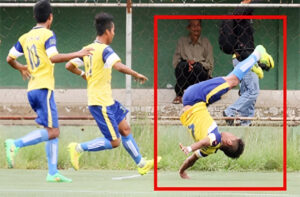
Celebrating a goal is a long-standing tradition in football; however, in October 2014, an exuberant celebration by 21-year-old Peter Biaksangzuala from Mizoram, India, turned into a horrific tragedy. After scoring, he performed a series of somersaults but lost control upon landing, sustaining a severe spinal injury that caused critical damage to his spinal cord. Although he was rushed to the hospital, he ultimately passed away at the age of just 21.
Let me now touch upon a few incidents from other sports.
In one match, Pakistani cricketer Abdul Razzaq did not wear a helmet and narrowly escaped a serious injury after being hit on the head by the ball. In another match, Pakistani bowler Wasim Akram took the risk of playing despite suffering a heart attack. While prompt medical attention certainly saved his life, the incident served as a stark reminder of the health risks associated with professional cricket.
But there is also a risk of death.
In 2014, Australia’s Phillip Hughes was hit in the neck by a bouncer during a Sheffield Shield match at the Sydney Cricket Ground. His spinal cord ruptured, causing a subarachnoid hemorrhage – a life-threatening bleeding in the space between the brain and the tissues. He died just three days before his 26th birthday, after being unconscious for two days. In another incident in 1998, while playing on a field in Bangladesh, Indian Test cricketer Raman Lamba was fielding at the ‘short leg’ position without a protective helmet. When the batter, Mehrab Hossain, struck the ball forcefully, it hit Lamba directly on the head. He collapsed immediately and suffered an internal hemorrhage; he fell into a coma and passed away three days later.
On February 27, 1878, during a friendly football match, William Bradshaw, a player for Colville, struck Herbert Doughty in the abdomen with his right knee. The referee did not deem the action a foul. Herbert Doughty, aged only 20, died the following day due to a ruptured intestine. On March 21, 1878, a jury acquitted Bradshaw of the charge of manslaughter.
In another old times example, on 25 October 1879 English player Harry Rogers, aged 25, captain of the Reading side called for medical help, stating that that he felt “bilious”. He lay down in the field, convulsed, and died.
In a recent incident, during a ‘Copa Perú’ match on April 10, 2025, Helar Gonzalez Altamirano was critically injured in a violent collision with the opposing goalkeeper while vying for a ‘long ball’; although he was stretchered off the field and placed in a waiting ambulance, the 21-year-old player passed away at the hospital.
In 2014, Australian Phillip Hughes was hit in the neck by a bouncer, during a Sheffield Shield match at the Sydney Cricket Ground, causing a vertebral artery dissection that led to a subarachnoid haemorrhage. He died after 2 days, never could regain consciousness, three days before his 26th birthday. In another incident Raman Lamba, a former Indian Test player died while on field, playing in Bangladesh.
On 6 February 2025, Guo Jiaxuan of China while playing preparation match for Beijing Football Association U20 squad in Spain for the 2025 National Games of China, he sustained a severe head injury with a Spanish club, his head collided with opposition player’s knee. Immediately a helicopter landed on the ground and carried him to the hospital and after four hours, he was declared brain dead. From Madrid, he was shifted to Beijing for medical care. On 19 March 2025, Guo passed away at Beijing’s Tiantan Hospital, one day before what would have been his nineteenth birthday. Guo Jiaxuan, aged 18 was a promising Chinese talent selected for the 2023 season’s Bayern Munich Squad.
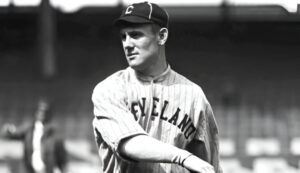
In 1920 Chapman died a few hours after he was hit in the head by a ball thrown by Yankees pitcher Carl Mays. He became the first and only MLB (Major League Baseball) player to-date to die from an injury that occurred during a major league game and his death raised the demand, specially from the ‘50s that baseball players need to wear helmets when at bat.
Now coming to recent incidents, on 10th April 2025, Helar Gonzales Altamirano died in hospital at the age of just 21 after a horror collision during a Copa Peru match when he smashed into a rival team’s keeper as they challenged for a long ball. Being wounded he was stretched away from the field to a waiting ambulance but died in the hospital.
The Scottish professional footballer Philip O’Donnell was PFA Scotland Young Player of the Year for 2 seasons. On December 29, 2007, his fate changed after a major cardiac arrest while playing a crucial match for Motherwell against Dundee United. Philip O’Donnell was immediately rushed to Wishaw General Hospital however the iconic football player couldn’t battle the excruciating pain and breathed his last a few minutes later.
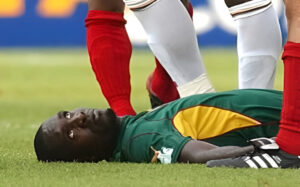
Cameroonian defensive midfielder, Marc-Vivien Foe was capped by his nation for sixty-two times. On 26th June 2003, before the scheduled FIFA Confederations Cup semi-final match against Colombia, Marc Foé’s wife Marie-Louise stated that Marc had been ill with gastric and dysentery, but he was adamant to play in his adopted hometown of Lyon. Cameroon manager Winfried Schafer also wanted to substitute him observing that the player seemed fatigued, but Marc signaled that he wanted to continue. In the 72nd minute of the match Mark Foé collapsed in the centre circle when no other players were near him. He was stretchered off the field, where he received mouth-to-mouth resuscitation and oxygen. Medics spent 45 minutes attempting to restart his heart and although he was still alive upon arrival at the stadium’s medical centre, he died shortly afterwards. A first autopsy could not determine cause of death, but a second autopsy concluded that Foé’s death was related to heart as it discovered evidence of hypertrophic cardiomyopathy, a hereditary condition known to increase the risk of sudden death during physical exercise.

Argentine Cristian Gomez was anticipated by his fans to be the “next big thing” in the world of football. But while playing a friendly football match for Atletico Parana, he collapsed on the field and died after a major heart attack. Although Cristian Gomez was given rapid medical attention, he passed away in the ambulance and couldn’t even make it to the hospital.
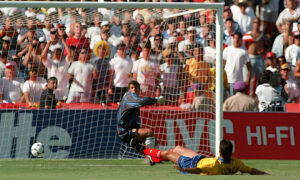
Colombian player Escobar accidentally scored an own goal during their FIFA World Cup group-stage match against USA. Colombia lost 2-1, which eliminated them from the tournament. On July 2, 1994, just days after returning to Medellín, Colombia, Escobar was shot six times outside a bar, after the assassin argued with him about his mistake in that game.
Formula One:
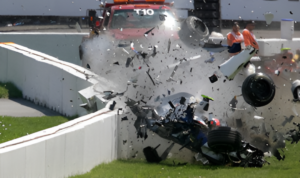
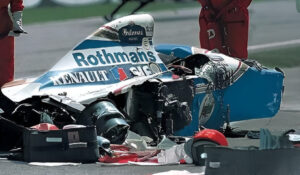
Brazilian Ayrton Senna was killed in an accident while leading the 1994 San Marino Grand Prix. This is undoubtedly one of the most shocking deaths in the history of any sport and Senna remains to-date the greatest and most recent driver to have been killed in a Formula One World Championship event.
The year 1994 is considered to be a black in the history of Formula One racing. The San Marino Grand Prix at Imola, Italy, was a race marred by tragedies. Thirty-one-year-old Austrian novice driver Roland Ratzenberger was killed in a high-speed crash during a qualifying session.
Big Bash League:
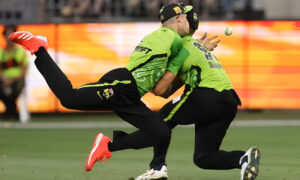
Sydney Thunder pair Cameron Bancroft and Daniel Sams were taken to hospital following a sickening clash of heads during their team’s pulsating four-wicket, final-ball victory over the Perth Scorchers. Bancroft’s BBL season was over with his broken shoulder and broken nose.
Track and Road Cycling Racing:
Even an apparently safe sport like cycling might be so fatal in a cyclist’s life.
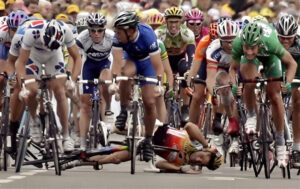
Isaac Gálvez López was a Spanish professional track and road racing cyclist who won the World Madison title twice in 1999 and 2006, both times partnering with Joan Llaneras. Sadly, he died in 2006 at the age of 31 due to injuries sustained in a crash during the Six Days of Ghent track race, appeared to have hit a railing with his chin and chest after crashing into a fellow Belgian rider.
Agostinho, the Portuguese bicycle racers and a six-time national champion. became the victim of one of the most ironic tragedies in the sport’s history. At Quarteira, during the 1984 Tour of the Algarve (he was leading at the time), a dog ran into the race a few hundred meters before the finish line and Agostinho hit it. He fell to the ground and injured his head, a trauma that put him in a coma a few hours later from which he never emerged.
Professional Basketball:

Few years after Len Bias’s unfortunate end, Reggie Lewis, another Boston Celtics star, died in his prime when he had cardiac arrest on the basketball court during an off-season practice session in the summer of 1993. Lewis had symptoms of heart problem a few months before, but after a few monthly treatments he was wrongfully cleared to train and play again.
Professional Wrestling:
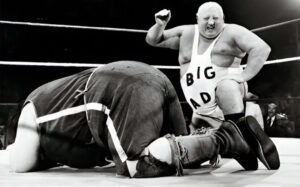
Malcolm “King Kong” Kirk and his partner, King Kendo, were in a tag-team match with Shirley “Big Daddy” Crabtree and Greg Valentine, when a most tragic events in professional wrestling’s history occurred. The incredibly massive Big Daddy was known for his signature body slams but when he slammed “King Kong” with his famous Belly Splash, Kirk turned gray and looked severely sick. He was immediately rushed to the hospital where he died moments later. According to the doctor who did the autopsy Kirk had a heart condition, so it wasn’t really Big Daddy’s Belly Splash that killed him, but it definitely triggered it.
Thus, various reason makes a player’s life difficult. Sometimes its the greed of playing more ignoring or hiding own health, sometimes due to greater pressure, sometimes lack of satety, sometimes too much of faith that “nothing wrong will happen”, even sometimes aggressive supporter might take away a player’s life. Thus, all but often a tragic end of career, sometimes the life.
Death Due to Stampede and Violence:
While on field the tragedy might happen for single or only a few individuals, but off the field, for example in the gallery, any chaos might take the life of hundreds of innocents.
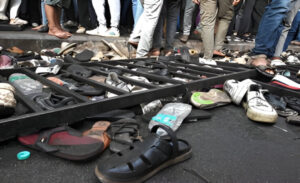
11 fans were crushed to death and more than 50 wounded in a stampede after uncontrolled huge crowd packed the streets in Bengaluru on June 4, to cheer their hero Virat Kohli and other RCB team members.
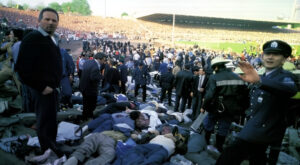
The 1985 European Cup final between Juventus (Italy) and Liverpool (England) was held at Heysel Stadium in Brussels. The Heysel disaster, which occurred on May 29, 1985, led to the deaths of 39 supporters (mainly Italian), 600 injured, and a blanket UEFA ban on English clubs from European competitions for five years (Liverpool for six years). What had started as a peaceful, joyful sporting event ended up looking like a war zone between the two teams’ hard-core fans in what is to this day the most tragic moment in European soccer history.
Peru’s Estadio Nacional Disaster (1964) – 328 Death and 500 Injured.
It was May 24, 1964, at Peru’s Estadio Nacional when Argentina was playing against Peru in a qualifier that would see the winner go to the Tokyo Olympic Games. Argentina was winning 1-0. When Peru scored a goal, the Uruguayan referee, Angel Pazos, didn’t count it (unfairly, according to the reports). This reaction ended up being the deadliest riot in soccer history (between fans and police) and resulted in the deaths of 328 people and saw as many as 500 injured.
Luzhniki Disaster (1982) – 66 / 340 Dead
The UEFA Cup match on 20th October 1982 between Spartak Moscow and HFC Haarlem took place in Moscow, Soviet Union in freezing weather and many fans began leaving early to escape the cold. Only one exit gate at the East Stand was open. When Spartak Moscow scored a late second goal, some fans tried to rush back to their seats, creating a deadly crush in the narrow stairway, which caused a stampede where many were crushed and suffocated. The Soviet government officially reported 66 deaths, but later investigations claimed the real number could have been as high as 340. The Soviets government’s secrecy at the time meant that the full scale of the disaster was kept hidden for years. The Luzhniki Disaster remains a grim example of poor stadium management, lack of crowd control, and the dangers of limited exit points.
Use of Tear Gas in the Stands.
The use of tear gas on the pitch and in the stands of a crowded stadium is prohibited under FIFA’s safety and security regulations. However, on October 1, 2022, at Kanjuruhan Stadium in Malang, East Java, Indonesia, many spectators were killed and injured following the use of tear gas after a football match between arch-rivals Arema FC and Persebaya Surabaya. The incident began when Arema FC lost the match 3–2, prompting supporters to breach the security perimeter and storm the ground. Security forces used baton charges and tear gas to disperse the crowd. The use of tear gas exacerbated the situation, sparking panic; as thousands of spectators rushed toward the stadium exits in an attempt to flee, 174 people lost their lives due to stampeding, suffocation, and crushing. Notably, the number of spectators present far exceeded the stadium’s capacity, which obstructed the escape routes.
The Match Continued Despite a Major Disaster in the Stands.
On April 5, 1902, during a match between Scotland and England at the Ibrox Stadium in Scotland, a large wooden stand collapsed. Twenty-five spectators lost their lives after plummeting onto the concrete below, and over 500 people were injured. However, in a highly controversial decision that shocked the world, officials after briefly halting play to deal with the casualties, resumed the match. They feared that cancelling the game could spark panic and further hinder the passage of emergency service personnel.
Earlier, on 2 January 1971, in the same stadium, when Celtic scored a late goal in a Rangers vs Celtic football match, many Rangers fans started to leave the stadium early to avoid the crowd. That was when Rangers scored the equalizer in the final minute. Hearing the roar of the crowd, some of the fans who were leaving tried to return to see what had happened. Then, in the sudden chaos between the fans who were leaving and the fans who were returning, people started falling down the stairs,
Kathmandu Stadium Disaster (1988) – 93 Dead
On March 12, 1988, a sudden hailstorm turned deadly during a football match at Dasarath Stadium in Kathmandu, Nepal when the stadium had around 30,000 spectators. They were panicked and rushed toward the exits to escape, but the gates were locked. As more people pushed forward, those in the front were trapped causing 93 deaths, mostly trampled or suffocated. With exit open exit gates open, a tragedy could have been avoided.
Hillsborough Disaster:
This incident occurred on April 15, 1989, at the overcrowded Hillsborough Stadium in Sheffield, England, during the FA Cup semi-final match between Liverpool and Nottingham Forest. Ninety-seven Liverpool supporters lost their lives and hundreds more were injured in the tragedy; it remains the worst sports-related disaster in British history.
Nature’s Decree:
In October 1998, during a match between the ‘Bena Tshadi’ and ‘Basanga’ teams in the Kasai province of the Democratic Republic of the Congo, lightning suddenly struck the field; all eleven players from the Bena Tshadi team lost their lives instantly. Around thirty spectators and other individuals at the venue suffered burns and various injuries. Astonishingly, however, not a single player from the opposing home team, Basanga, was injured. Since every member of one group lost their lives to a lightning strike while another local group remained completely unharmed, this mysterious incident sparked widespread debate about sorcery and curses.
The Munich Air Disaster:
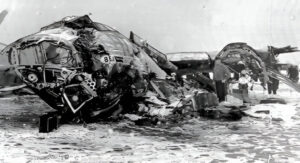
On February 6, 1958, British European Airways Flight 609 crashed on its third attempt to take off from a slush-covered runway at Munich-Riem Airport in West Germany, which caused the death of twenty of the forty-four passengers on-board. The injured, some unconscious, were taken to the nearest hospital where three more died, resulting in twenty-three dead, the vast majority of them players were from the Manchester United club.
Iraq’s Extermination of Athletes, 2006:
In the dying days of Saddam Hussein’s regime, a series of attacks on athletes left nearly 50 athletes and coaches either dead or “missing”. On May 17, 15 athletes and officials from a taekwondo team were kidnapped as they were heading to a training camp in Jordan. None were seen alive again, and remains of 13 of the squad were found a year later in the desert. Then on May 26, gunmen shot and killed the Iraqi national tennis coach and two of his players in Baghdad. Their crime was wearing shorts, something that Islamic extremists had warned in the days preceding the attack. And again, on July 16, about 50 gunmen made a daytime raid on a conference centre in Baghdad and kidnapped 30 Iraqi sports officials, including Ahmed al-Hadjiya, the head of Iraq’s Olympic committee.
References:
** sportsdigest.in/footballers-lost-lives
** list25.com/25-tragic-sports-
** www.mirror.co.uk/sport/football/news/
** https://www.youtube.com/watch?v=1XVcmhHoh84
** www.nytimes.com/2010/06/07/sports/
** www.90min.in/posts/4321760-10-instances
** www.espnfc.com/blog/espn-fc-united-blog/68/
** en.wikipedia.org/wiki/Franz_Beckenbauer
** www.complex.com/sports/2013/06/
** www.joe.co.uk/sport/
** Economic Times, Joe.co.uk, NYTimes

********




A very new area you have nicely described. This required a wide home work to pile up so many similar incidents of injury from different national and international fields. I am not sure whether earlier any one else has penned down such an interesting and informative article. This requires a wide effort to collect and project on papers.
Thanks for taking the successful effort.
An article on uncommon subject. I have never read so far any article on disaster in sports, be it on the field or off the field. On reading we can make out how much time the author had to spend collecting the information on so many different types of sports.
I wish author would come up with many more such articles in the future.
Thanks author, it’s worth reading.
বিভিন্ন ধরণের খেলাধুলায় চোট আঘাত বা মর্মান্তিক দুর্ঘটনা নিয়ে এরকম লেখা আগে পড়িনি। একেবারেই ভিন্নধর্মী স্পোর্টস বিষয়ক লেখা।
You rightly said, today’s greed of sports, the business interest and playing more and more tournaments at greater pressure even if your health does not permit, but you or your club insist to continue. Many hazards are avoidable but who cares?
On the other side, there is administrative negligence.
Sports is generally a form of art, but often a nightmare, that comes without any notice.
Well written article on important but unusual subject. I have not gone through any such article in the past.
While most of the accidents are in the hands of God, but often players, sometime the clubs, sometime the organisers create many many disasters. Might be individual greed, might be trying to be in the race, but the fate becomes unfortunate.
It’s good that author did a good job to bring it in common.
খেলাধুলায় যেমন জয় পরাজয় আছে, তেমনি মর্মান্তিক পরিণতিও আছে। Sports and Disasters বিষয়ে আর অন্য কোন লেখা আমার জানা নেই, থাকলেও সংখ্যায় খুবই নগণ্য হবে।
কেন হয়, কিভাবে হয় উদাহরন সহ বিশদে বর্ণনা করা হয়েছে।
খেলাধূলার অনিয়ন্ত্রিত পরিনতি নিয়ে এই প্রবন্ধটি খুবই প্রাসঙ্গিক।
Feeling sad after reading so many tragic ends, be someone’s sports career or someone’s life. Sometimes it’s individuals, and sometimes the crowd who gathered to enjoy the fun of sports. The reasons for all the tragic ends are well written.
Good article describing the other side of sports.
Gone through the write up, author has almost covered all the possibilities of a disaster in sports. I would add, giving examples of some of the greatests like Maradona and George Best, that you need to bring yourself under certain non negotiable disciplines. Indian examples are Majid Baskar, Vinod Kambli, may be bowler Srishant, may be few more.
Well written article, highlighting the necessity of utmost care by all concerned.
Accident and its aftermath is an important part of any field, more so of sports arena. It must be a herculean task for the author to gather all the related information. I must say his efforts have made this article an attractive one.
Thought provoking.
I have not read any such article in the past that raises concern for our safety in sports, be it on the field or off the field. Many valid reasons are highlighted how or why these disasters happen. We wish people should be sensible and aware of such possibilities and protect them from such mishaps.
Good article to read.
My sincere thanks for the author, for his hard work and presenting such a composition.. With my full regards for you, I would add two incidents.
First, the Hand of God goal was a disastrous management failure of FIFA..
Second, when Sukolyan Ghosh Dastidar punched on the referee’ nose after the Calcutta durby match sometime around mid 70s.
It’s a wonderful document author, I just wanted to add two incidents.
Thanks
I have taken part in sports only during my school days. It has risk involved, small or big. This article should be a lesson for the sports persons, and even for the administrators.
A good composition of risks and disasters on the field. But there are many examples of sportspersons after earning fame and handful of wealth get addicted to alcohol or drugs or in gambling, on women or so. They not only ruin themselves but also their families.
These are examples of disasters off the field.
এটা একটা অসাধারণ লেখা, এই ধরণের লেখা সাধারণত লেখা হয় না। বিভিন্ন খেলোয়ারদের তাঁদের খেলার ধরণ এবং তাঁদের প্যাশন নিয়ে বলা হয়েছে। এরসাথে এটাও বলা হয়েছে : এখনকার দিনে সব খেলাতেই এতো কম্পেটিশন এবং সাথে এতো এতো টাকা হয় যে প্লেয়াররা তাঁদের শরীর বা স্বাস্থ্যের কথা মনে না রেখেই বেশিরভাগ সময় বিভিন্ন রকমের রিস্ক নিয়েও খেলে যেতে থাকে। তাতে অনেকেরই জীবন বিপদ জনক মোড়ে এসে দাঁড়িয়ে যায় আর তাতে তারা সারা জীবনের জন্য খেলার মাঠ ছাড়তে বাধ্য হয়। আমার ধারণা যেকোনো বিখ্যাত প্লেয়াররা তারা তাঁদের জীবনের বাজী রেখেও অনেক সময় তাঁদের খেলা চালিয়ে যায় সেটা শুধু যে টাকা পয়সার জন্য করে সেটা ঠিক নয়, এটা তারা করে তাঁদের মাত্রা অতিরিক্ত প্যাশন এর কারণে এবং খেলা তাঁদের কে এতটাই উন্মাদনা এনে দেয় যে এরা এদের শারীরিক ক্ষতির পরোয়া না করেই খেলা চালিয়ে যায়। এর ফলস্বরূপ বেশিরভাগ ক্ষেত্রেই তাঁদের শারীরিক ক্ষতির পরিমান একটা সাংঘাতিক ক্ষতির দিকে এগিয়ে নিয়ে যায় এবং তার ফল তাঁদের সারা জীবন ভুগতে হয়। এটাই হয়ে চলেছে যুগ যুগ ধরে। এরা সবাই একেকজন আমাদের কাছে সেলিব্রিটি বা লেজেন্ড হয়ে ওঠে।
লেখককে এইরকম একটা লেখা প্রচুর তথ্য সহকারে আমাদের সামনে উপস্থাপনা করার জন্য আন্তরিক আন্তরিক শুভেচ্ছা রইলো। 👌🏽👏🏽❤🙏🏽
খেলাধুলায় চোট আঘাত হবেই, কিন্তু লেখক যেভাবে নানান তথ্য দিয়ে বিভিন্ন উদাহরণ দিয়েছেন, সে সত্যি ভয়াবহ। খেলোয়াড়রা আরও অর্থ বা খ্যাতির জন্য হোক বা নিজের মানসিক দৃঢ়তার অভাব হোক, এইরকম পরিণতি কখনোই কাম্য নয়। পেশাদার মহলে যদি এই ব্যাপারে কাউন্সেলিং হয় তাহলে অনেক প্রতিভার অকস্মাৎ অকালমৃত্যু আটকানো যাবে।
লেখককে ধন্যবাদ এরকম প্রতিবেদন লেখার জন্য।
Sports and accidents are related, though never desirable but it happens. But it is the saddest part if it turns out to be horrible mishaps. It can be controlled to a great extent if personal councelling can be made a routine in various games.
Author has rightly pointed out various causes with examples.
Wish, good sense prevails in sports community.
Thanks.
আমি ছোটবেলায় স্কুল কলেজে খুব একটা খেলাধুলা করিনি, কারণ ছোট আঘাতের ভয় পেতাম। নরি কন্ট্রাক্টরের ঘটনা খবরের কাগজে পড়েছিলাম। আমার মনে ভীষণই ভীতি এনে দিয়েছিল।
এখন পেশাদার মহলে অনেকেই বেপরোয়া হয়ে নিজেকে ধীরে রাখিতে পারেন না। আরও খ্যাতি, আরও অর্থ চাই। যদি এই ব্যাপারে কাউন্সেলিং হয় তাহলে অনেকেই হয়তো বিরাট দুর্ঘটনার শিকার হবেন না।
আপনার লেখাটি খুবই গুরুত্বপূর্ণ। আমি আমার পরিচিত মহলে শেয়ার করব।
ধন্যবাদ।