
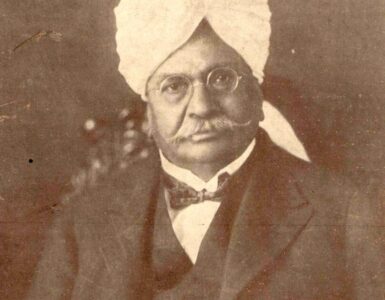
 Asim Deb
Life and Works of Dr. Anath H. Pandya
Just before the beginning of the Second World War, the Bengal Engineering College at Sibpur was seeking a new Head of the institution. This post had always been held by an Englishman and, thus, the advertisement came in the London papers only. Anant, living in England at that time applied and was selected and recommended by the English Committee, but the Government of Bengal hesitated and referred the matter back to London, but, again, the Committee recommended Dr. Pandya, and in September 1939, Dr. Anath H Pandya was appointed as its first ever Indian Principal of Bengal Engineering College. Pandya family rushed to leave London before the war, and it was one of the last ships for them to leave for India. Most of their baggage went to a watery grave aboard a following vessel, sunk by German submarines. He was aged only thirty when he took over the charges of Bengal Engineering College. That was the early days for Dr. Anant H. Pandya (1909 – 1951), the engineer, educator and public servant, who was later recognised as the pioneer of India’s industrial, and educational future.
Early Life
Anant was born on July 11, 1909, at the Pandya family of Bhavnagar, Saurashtra in Gujarat. His father, Hiralal H. Pandya, during his childhood, was completing his education in the United States. On return he joined as an agricultural engineer of several princely States. Anant grew up in Bhavnagar under his grandfather’s care.
From early childhood, his education at the Dakshinamurti Vidyarthi Bhavan emphasized overall development, with Indian music, art and culture, taught science first-hand in the surrounding fields and hills. He also served as a volunteer in Mahatma Gandhi’s camp, came in contact with Rabindranath Tagore, studied physical culture with revolutionary Prithvi Singh, and music of many of India’s foremost musicians. Creativity and individual thinking, patriotism and national feelings were emphasized, and Anant became the school’s best student and also an artist.
As an adolescent, Anant and his cousin cum companion Upendra Bhatt, started a hand written monthly literary magazine, Kumar. Anant did the illustrations and won several prizes for paintings and drawings. At the age of fifteen, he and his cousin Upendra had to take a crucial decision. Upendra relates: “If we wanted to pursue the study of literature, economics and social sciences or wanted to join the upsurge of nationalism, the way was clear to Mahatma Gandhi’s Gujarat Vidyapith. If, however, we wanted to pursue science or engineering, there was no other go, but to pass Matriculation of the Government sponsored University. In those days of fight for freedom, it was considered a sin to go to a government school. On the other hand, we felt that science and engineering were inevitable for national reconstruction. Our trusted teachers analysed the situation of self-aggrandizement (Government school of engineering) versus renunciation (Gujarat Vidyapith). Certain desires, ambitions and attitudes led us to the path of science.”
Education
They passed Matriculation from Bombay University, then studied for a year at Samaldas College in Bhavnagar and then, in June 1926, took admission at Gujarat College, Ahmedabad, for science. In 1927 Anant passed the Inter-Science and joined the Engineering College in Karachi, where they established the First Congress Youth League, to protest against Gandhi’s imprisonment, and fasting to save money for flood victims. Finally, Anant became the first class topper for all the three years in engineering studies with several scholarships and gold medals including the coveted James Berkeley Gold Medal. Opportunities were open in the Indian Services of Engineers and also for scholarship in the best British Universities, but Anant decided to join the world renowned Massachusetts Institute of Technology, (M.I.T.) USA.
Anant excelled in all the subjects, secured extra-ordinary marks in the subjects he selected. With additional assignments during the summer of 1931, he was qualified for the degree of Master of Science in Civil Engineering. In his second year, Upendra and Ramesh joined him at M.I.T. Upendra Bhatt relates: “The American way of life demonstrated to us the ideal of individual liberty and democratic social order. We, students, formed the Hindustan Association and expressed our national aspirations. We realized that America’s wealth and strength consisted in development of the country’s resources through Technology, and we also dreamt and planned the development of India on the same lines’
Anant secured the Austin Research Fellowship for research in Soil Mechanics and within a year and a half he completed his thesis on “The Design and Construction of Ports and Harbours”, and also another work on “Large Dams”. By August 1932, at the age of 23 he was elected a Member of the American Society of Civil Engineers. In 1933, he was one of the first and youngest to receive the Doctorate of Science in Engineering. Many of his professors considered Anant the finest student of their teaching career. He was elected an Honorary Fellow of the Institute.
Outstanding Career
He returned to India at a time of economic depression (late 1933) when American degrees were ‘unrecognised’ in India by the British influenced economy. He got a job in a junior design position in the Mckenzies Ltd., of Bombay, at a stipend of Rs.250/- per month. But he could realise that there was no opportunities elsewhere in India. So, he left for London in autumn 1935 and within fortnight, he was hired for a major position by the large international firm of Trussed Concrete Steel Co. Ltd. In early 1936, he was deputed to India as an adviser of M/s. Hindustan Construction Engineering. Co. Ltd., which had earlier refused to hire him (because of his American qualifications) in the design of earthquake proof buildings at disaster-struck Quetta.
During his brief stay to India, Anant married Shrimati Lilyben Shah and both of them returned to London. While in London, he was responsible for the development of new design and construction in steel and reinforced concrete and for research in welded structures. In November 1937, in appreciation of his merit, he was elevated to the position of the Chief Engineer of Diagrid Structures Ltd., a subsidiary of Trussed Concrete. In September 1938, he was awarded the James F. Lincoln Arc Welding Foundation International Prize of $32,000 for a paper on “The Arc-welded. Grid Applied to Plane and Spatial Structures”, written in collaboration with his assistant, Mr. R. J. Fowler. During this period, Anant made a special study of Structural Air Raid Precautions in England and prepared his own design for a reinforced concrete shelter, and received praise and appreciation with a merit prize for it. In 1939, he took out British Patent 512867 (also later patented elsewhere) on his process for “Continuous Cranked Beam Construction”. His superior at Trussed Concrete, E. R. Hole, remarks: “Many contracts involving engineering design of a high standard in both concrete and welded steel stand to the credit of Dr. Pandya both in Britain and overseas, and they range over almost the complete scope of industrial, public and domestic building, including aircraft hangers and large factories.”
By then just before the beginning of the Second World War, the Bengal Engineering College at Sibpur was seeking a new Principal. The post had always been held by an Englishman and, thus, the advertisement came in the London papers only. Anant applied and was recommended by the English Committee, but the Government of Bengal hesitated and referred the matter back to London, but, again, the Committee recommended Dr. Pandya, and in September 1939, Dr. Anath H Pandya was appointed as its first ever Indian Principal. Pandya family rushed to leave London before the war, and it was one of the last ships for them to leave for India. Most of their baggage went to a watery grave aboard a following vessel, sunk by German submarines.
Dr. Anant Pandya was aged only thirty when he took over the charges of Bengal Engineering College. In addition to his duties as Head of the Engineering College, he distinguished himself as a member of the Senate and Syndicate of the University of Calcutta, a faculty member there and at Rajputana University, also an advisor to Benaras Hindu University and a Member of the Central Advisory Board of Education and numerous other special Committees of Education for both the Central and Bengal Governments.
Dr. S. R. Sen Gupta, his faculty colleague and later the Principal of Bengal Engineering College, Sibpore and also later the Director of I.I.T., Kharagpur, remarks: “He was kind and courteous to all concerned, students and staff, from the poorest paid employee to the senior most Professor…. After the outbreak of war, Dr. Pandya was one of the first to realise that it would be essential to extend the technical training facilities for the training of craftsmen, and I know personally that he took the initiative in writing to all the important government officers and placing the facilities of college at their disposal—. He has done more for this college than anyone else before or after him.”
In April 1943, Dr. Pandya was transferred to the Department of Industries and Supply as the Controller of Metals where he was outstandingly successful, and soon he was promoted to the position of Dy. Director-General of Munitions Production, a post during British rule was never held by any Indian. After the war, he was offered a major post with the Central Government’s Planning Department, but politics and communalism intervened, and he was not, finally, offered the post.
During this period Dr. Pandya was made a Member of the Planning Commission, which was established under the Chairmanship of Pandit Jawaharlal Nehru. Dr. Pandya submitted the project to establish five IIT’.’s across Indian cities on the concepts of Massachusetts Institute of Technology. Thus he was one of Architects of founding the Indian Institutes of Technology (IIT) in India.
Dr. Antia, his friend and the former Director of Union Carbide in India, said: “To harness the big rivers and make them work for the prosperity of the country, to modernize agricultural methods and to make engineering serve the country in such a way as to abolish hunger and want. His main aim was to gather a group of Indian engineers to start a consultancy service. It was not necessary to place foreign consultants on a pedestal as done hitherto. Indian engineers could do as well or even better.”
Dr. Pandya became the Director and Chief Consulting Engineer of Hind Constructions Ltd, Calcutta, and secured contracts for the big and complicated projects like construction of tunnel at the Bhore Ghat for the Central Railway, the building of the tunnel for laying the pipe line for the Vaitarna-cum-Tansa scheme of the Bombay Municipality and construction of the Konar Dam and other projects for the Damodar Valley Corporation, development of the ports of Saurashtra, Kandla Project (Cutch). In these projects,
Early in 1949, Dr. Pandya was offered the position of General Manager, Hindustan Aircraft Ltd (HAL)., at Bangalore., and he was the first Indian national to be appointed as General Manager of HAL. During World War II, the management of HAL was solely in the hands of American technicians. C. V. S. Rao, then the Director and colleague at Hindustan Aircraft, said, “Anant infused a new spirit and created a new atmosphere altogether. His charming manners and sympathetic and tactful handling of the personnel won for him the hearts of the staff and the rank and file, while his undoubted mastery of general engineering commanded the respect of even experts in aircraft engineering of which he did not profess to know much. The outstanding event of his brief stewardship was the formation of definite plans for manufacture of Trainer Aircraft. The first planes of Indian design and manufacture in independent India”.
His Sudden Death
When Dr. Pandya could successfully set Hindustan Aircraft on a new and vigorous path, in a brief nine months, he moved his family to Bombay. He was now, primarily, associated with Patel Engineering and looked forward to building it into a pre-eminent firm for large construction projects in India, and eventually, perhaps, elsewhere in the newly developing countries. From December 1949, until his death in June 1951, he pursued large construction projects of dams, ports, and tunnels, including ports in Gujarat, dams in eastern India, and tunnels near Bombay. That was the time, he was instrumental in planning the foundations of Indian Institute of Technology (IIT). To understand the new techniques and purchase needed equipment, he travelled to Germany, France and the U.S.A. in 1950, and to Germany and Scandinavia in 1951. While returning to Calcutta, after inspection of Konar Dam in Darnodar Valley, on June 1, 1951, the car in which he was sleeping was struck and he was killed. He passed away from physical sleep to death, at the age of only 41.
In closing, let me quote Dr. Sudhir Sen, who worked with Anant in Damodar Valley and was later an economic adviser in the United Nations, and with Dr. Pandya himself. “You could almost see the fire of youth ablaze in his soul; capable of grim resolve and great tenacity; and crowning all, he had an unbending faith in his own future and in the future of his country. All these, taken together, made of him the most forceful and colourful personality I have ever known. . . . It was his dream to lift the contractor’s profession in India to a new level of dignity and integrity, just as the Tagore family, not long ago, rescued Indian music and dance from the gutter, gave them the stamp of social acceptability and turned them into a source of beauty and joy for all. This was his dream. And I have no doubt that he would have realized it, only he had lived long enough.”
Dr. Anant H. Pandya began as an artist, sketching scenes in Bhavnagar and remained an artist until his death—an artist of dams, and tunnels and ports and harbours, an artist of schools and factories, an artist of his country’s future and of life itself.
His quote:
“The principle of intellectual training in and through a craft is the most fundamental feature …. The true function of education is a creative one. . to create new forms of skill and by doing so to confer a higher social status upon occupations which do not at present possess it, or, as is the case in some crafts, have lost or are tending to lose it…. There is no substitute for experience, Each of us must go through the Mill’.”
Source: Indian National Science Academy
& excerpt from an article by Lily Pandya.
I seem to have been only like a boy playing on the seashore, and diverting myself in now and then finding a smoother pebble or a prettier shell than ordinary, whilst the great ocean of truth lay all undiscovered before me.
– Isaac Newton
******





I stayed in Pandya Hall for about two years during my post graduation. Ashim’s article has described his life in detail. During his tenure, the whole world was experiencing the 2nd world war. In India, additionally freedom movement was going on. He kust have also had much trouble in running the college.
From the article, I came to know, he was one of the person behind establishment of five IITs.
Thanks the author for a well researched article.
Thanx Asim. It is an exceptionally good article and I love it and preserve it. It was very sad that he died at the age of 41 only. In the caption and somewhere else, Anant appears as Anath . HAL is Hindustan Aeronautics Limited (HAL) and not Hindustan Aircrafts Limited.
আমিতো তোমার ওঁর সম্বন্ধে লেখা আগে পড়েছি ও অভিভূত হয়েছি | এটাতো মনে হচ্ছে সেই লেখাটাই | যাই হোক ইঞ্জিনীয়ার হিসেবে আমাদের এইরকম লোকের সম্বন্ধে চর্চা করাও কর্তব্য | লেখাটা দুর্দান্ত হয়েছে |
তুমি স্যার গঙ্গারামের সম্বন্ধে পড় | অবাক হয়ে যাবে | উনি ইঞ্জিনিয়ার ছিলেন | আমি পড়ে থ হয়ে গেছি, তুমিও হবে।
শ্যামল মিত্র
বি ই কলেজ, ১৯৬৭ সিভিল ইঞ্জিনিয়ারিং
Dear Asim, It is not clear if it is addressed to me or to a cluster of alumni- however, my inputs are as under:
..This is an exhaustively researched article. Our generation who entered BEC much later than his demise can’t contribute much.
.. There are duplication of facts which need to be edited ( can do it if necessary),
.. Also some hyperboles, like comparing his skills with that of Tagore who gave respect and recognition to cultural performance.
Worthy effort by you editors 👍
Amitava Ghoshal
B E College, 1957 Civil Engineering
Dr Pandya was only 41 when he died. What he achieved in these few years from the age of 21 to 41 is quite astounding. Although he was educated in the West he dedicated his life and enormous skills and knowledge to the betterment of lndia. He was a kind polite and a generous person. His contribution. to BE College and creation of llTs was remarkable vision and a great engineering and science asset of lndia.. May his memory and contributions to higher education be ever-present and acknowledged.
Asim
Hello, thank you and well written.
Furthermore, your desire to research and write in Bengali is excellent. I hope to see a book or two in the future.
Good luck.
Biman Ghosh
BE College, 1964 Architecture
A beautifully written tribute to the legendary technocrat and educationist, Dr. A. H. Pandiya.My salute to the great persolity. Thanks to the author. I expect of reading more such articles on legendary Engineers in future.
Thanks author, for the short biography of an unknown but great Indian Engineer. I would understand He was one of the earliest architects of the nation, who bought great engineering changes in the country.
Wish to get more such interesting write ups from Asim Deb.
আমি ইঞ্জিনিয়ারিং বিষয়ে পড়াশোনা বা পেশা, কোনটির সাথেই যুক্ত নই। এনার নাম পরিচয় আমি আগে শুনিনি। এটুকু জানি ব্রিটিশ ইন্ডিয়া আমলে অনেক ভারতীয় নিজেদের প্রতিভা ও স্থান প্রতিষ্ঠা করতে পেরেছিলেন, এবং ব্রিটিশরাও তাঁদের যথাযোগ্য স্বীকৃতি দিয়েছিলেন।
এই লেখাটা পড়ে অনেক কিছুই জানা গেলো কিভাবে নিজের মেধা ও সাথে ইচ্ছা একাগ্রতা নিয়ে উনি সাফল্য অর্জন করেছিলেন।
আজ এক বিরাট মাপের উদ্যোগী মানুষের কথা জানলাম।
If I am not wrong, from our general category of books and magazines and social media, we know about many famous sceintists, matematicians, but comparatively not so many number of engineers. Whatever I could read from this article, this man’s social recognition should have been at par with Dr. Homi Bhava, mathematician Ramanujam, and such famous people, but this man’s name is not encrypted in our herat, not in our general awareness and not in our database. Seems engineers get let focus in books and media.
Anyway, my gread regards for the man who gave a lot to our country.
Thanks author.
Being an ex student of BE College, today I feel a shame that not me alone, but the whole mass of BE College is not aware of such a great man.
In every aspect of his studies and works, he established himself different and better than others. In his works, be an administrator in academic institution, or in industry, he always excelled.
My heartful tribute and regards for the man.
Thanks Asim Deb, for sharing it.
বি ই কলেজের ছাত্র হয়ে ড: পান্ডিয়ার নাম শুধু শুনেছি, প্রথম ভারতীয় প্রিন্সিপ্যাল, এর বেশি ওনার ব্যাপারে কিছুই জানা ছিল না।
এবার এই প্রতিবেদন পড়ে আমার নিজেরই খারাপ লাগছে যে এত গুণী ব্যক্তির ব্যাপারে শুধু আমি কেন, আমরা কেউই ওনার ব্যাপারে অবগত নই। শুধু বি ই কলেজের শিক্ষাব্যবস্থায় নয়, বিভিন্ন বড় বড় ভারী শিল্প প্রতিষ্ঠানের প্রধানের দায়িত্ব সাফল্যের সঙ্গে সম্পাদন করেছেন।
নিঃসন্দেহে বলবো, সেই সময়ের ভারতের তিনি একজন উল্লেখযোগ্য প্রযুক্তিবিদ ও পরিচালক।
মাত্র ৪১ বছর বেঁচে ছিলেন, নইলে আরও অনেক কিছু আমরা পেতাম।
লেখককে সাধুবাদ, আমাদের কাছে ওনার বায়োগ্রাফি শেয়ার করার জন্য।
Outstanding blog.
I acknowledge your passion for all such unknown or little known subjects, and then make a beautiful presentation in texts.
From where you track all the information?
Truly commendable.
One question strikes me. Like our Homi Bhabha’s tragic death, many think that it was a conspiracy, I will not be surprised if there was/were people with vested interests against such a powerhouse of talent, a man who was ahead of his time.
Death at the age of 41 in a road accident, a tragic end of one of the pioneer engineering architects of India.
Subhashis Sanyal, BE College, 1976.
This is a well composed write up on Dr. Anant H Pandya. He was the first Indian principal of our Bengal Engineering College.
Here in the well informative article we find the detailed Life and Works of Dr. Pandya. His biography is presented here by the author.
A well fruitful effort.
This write up about an unsung hero, Dr. Anant H Pandiya, is heart warming. People like them have been pioneer and real architect of modern India.
Thanks to Mr Asim Deb for introducing us to life and achievement of such an outstanding genius.
অসীম, তোমার লেখাটা পড়ে Dr Ananth Pandye সম্বন্ধে অনেক কিছু জানলাম। উনি এত কম বয়সে ( ৪১ বছর বয়েসে মৃত্যু) শিক্ষা ক্ষেত্রে কত কিছু অর্জন করেছেন। কলেজে পড়ার সময় উনার নামে একটা হস্টেল ছিল সেই নামেই জানতাম। উনি যে বৃটিশ রাজত্বে আমাদের কলেজের প্রথম ভারতীয় প্রিন্সিপ্যাল তোমার লেখা পড়ে জানতে পারলাম। এছাড়া উনার অন্যান্য কীর্তির কথাও জানলাম। আমাদের সময়ে প্রথম দুবছর বেশ কয়েকটা non-engineering সাবজেক্ট পড়তে হতো । যেমন Humanities , economics , ইত্যাদি। কয়েকটা ক্লাশে যদি আমাদের পুরনো প্রিন্সিপাল বা distinguished প্রফেসরদের নিয়ে আলোচনা হতো , আমাদের একটা গর্বের জায়গা তৈরি হতো।
Very informative article. I am pleasantly surprised to find way back in 1930, an Indian engineer studied in an institute like MIT. May be he could be a contemporary of Dr Amar Bose of Bose audio system fame who was associated with MIT in multiple ways.
Apart from MIT study, His “resume” is so decorative, that a পাতি backbencher engineer like me is simply amazed to read his cascading achievements.
Salute and regards to our Pandya da (SIR).
Also convey a sincere thanks to Asim Deb for making us aware about Him.
Himangshu Nath 1977 EE
An exceptional biography, in short and easy texts.
I won’t say much, because it’s already there. Only what I would say is that being invited from England and becoming the Chief Administrator (Principal) of the premier institution like BE College at the age of only 30 that says a lot.
I have read another biography by the same author, on Amar Gopal Bose, who was also a pioneer in his own empire. The difference is Dr. Bose was a scientist inventor, and Dr. Pandya was a towering personality in engineering. Dr. Bose is little bit known to the Indian community, Dr. Pandya is not, and that’s the unfortunate reality.
Thanks author for your the article.
This one stands for exception as I am sure even in the engineers circle He is not so known.
I acknowledge the author’s efforts to search for such an outstanding achiever who was brilliant in all the fields that he has worked.
With great care I have read the content. Truly commendable presentation.
Tragic death at such an early age in unfortunate accident, ends the works of one of the pioneer engineering stalwarts of India.
I often wonder, why many of prodigies of our motherland died so early.
Dattatreya Vishnu Paluskar, Harinath Dey, Ramanujan… a few to name.
Dr A H Pandya prolongs the list.
Never knew name of this genius earlier.
Your this story, written after a meticulous and hard work, let me and many readers, to know him in right perspective.
No words suffice to praise your such effort.
Yes
I have read the article & you have done a thorough study about Dr. Pandya and a lot of facts u hv shared about him. I am sure these are not known to even the faculties and students/ex-students of our college!