
 Asim Deb
Women’s Cricket, from its Earliest Days
Compiled by: Asim Deb
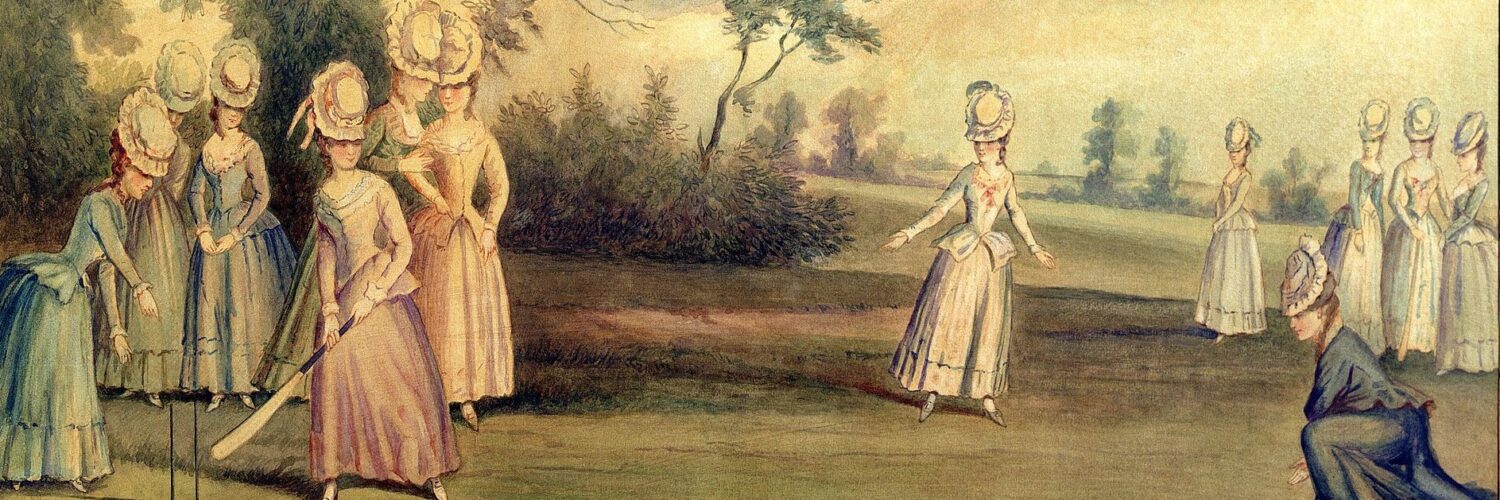
Cover photo: 1779 cricket match played by the Countess of Derby and other ladies.
While women’s cricket has faced challenges, it has also grown significantly due to their will power. The first Women’s World Cup was held in 1973 that was two year before ICC could host the Men’s World Cup.
In 1963, the well regarded England captain Len Hutton famously said during a charity match against a women’s side that women playing cricket was “absurd, like a man trying to knit” (the women went on to win the match). Views like Hutton’s were so common those days.
Going back to the records, we find that women have played cricket for centuries. The first recorded women’s match took place in 1745 in Surrey between “eleven maids of Bramley and eleven maids of Hambledon”. According to the Reading Mercury paper: “The greatest cricket match that was played in this part of England was on Friday, the 26th of last month, on Gosden Common, near Guildford, between eleven maids of Bramley and eleven maids of Hambledon, all dressed in white. The Bramley maids had blue ribbons and the Hambledon maids with red ribbons on their heads. The Bramley girls got 119 notches and the Hambledon girls 127. There was both sexes the greatest number that ever was seen on such an occasion. The girls bowled, batted, ran and catches as well as most men could do in that game”.
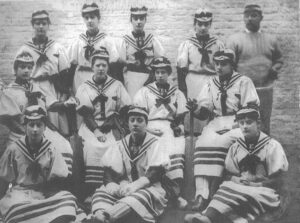
Photo: English Lady Cricketers 1890
Contemporary records show that women’s matches were played on many occasions between villages in Sussex, Hampshire and Surrey. Prizes ranged from barrels of ale to pairs of lace gloves. The first county match was held in 1811 between Surrey and Hampshire at Ball’s Pond, Middlesex.
The first women’s cricket club “White Heather Club” was formed in 1887 at Nun Appleton in Yorkshire. In 1890, a team known as the Original English Lady Cricketers toured England, playing exhibition matches. It became popular but its manager absconded with the profits, forcing the ladies to disband.
Thus village matches became common in the county grounds and between 1890 and 1918 over 140 women’s clubs were formed. These games could attract a lot of interest: One such match between the Charlton and Westdean & Chilgrove villages in Sussex in 1747 had to be curtailed because of a pitch invasion by an overly rowdy crowd!
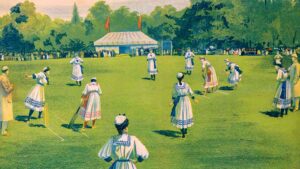
The “Original English Lady Cricketers”, a touring band of 22 women who played a series of exhibition matches at English county grounds in 1890, were unusual in being paid to play. By the late 19th century most women’s teams were made up of aristocratic ladies. Girls from wealthy families also sometimes had the chance to play at the new girls’ public schools like Roedean and St Leonards, though other schools banned the sport for being “unladylike”.
Before 1900 women usually played wearing long skirts and blouses, and sometimes wore bonnets. It is rumoured that Christina Willes, whose brother John was the first cricketer to bowl a round-arm delivery at Lord’s in 1822, invented this method because the ball was becoming entangled in her skirt when she bowled underarm.
During the First World War (1914-1918), the games were played in army barracks, training depots, military camps, munitions factories and workplaces, and on hospital grounds. As women’s role in public life grew after the war, so did wider acceptance of women’s cricket. Then until 1926, women’s cricket matches were mainly village matches tended to be one-offs, played for prizes, may be just a plum-cake or ale.
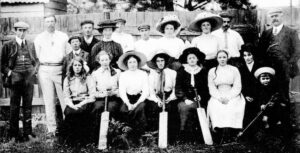
Photo: The Kingston women’s cricket team 1910.(Supplied Channel Museum)
The foundation of the Women’s Cricket Association in 1926 marked the new era of organised, national competitions in England. The first match on a first-class county ground, was hed at Worcester in 1932. On the other side, in 1931 the formation of the Australian Women’s Cricket Council (AWCC) created the first opportunity for a global women’s cricket tour. The Secretary of the English Association Vera Cox met a member of the AWCC while on holiday in Australia, the AWCC wrote to the Women’s Cricket Association (WCA) in spring 1934 inviting them to visit that same year. The English team set sail for Australia on 19 October 1934.
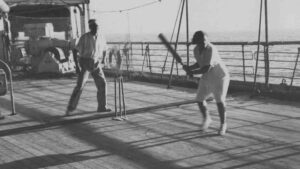 Photo: Deck cricket, England on board SS Cathay, first tour to Australia, 1934 (WCA Archive)
The players on the 1934-35 tour had to pay for their ship tickets to Australia, which cost £94 and 10 shillings (about £4,800 in today’s money). This first England team was not, therefore, selected on merit: the WCA sought applications if anyone could afford to travel cost.
England won two of the three Tests against Australia, as well as their one Test against New Zealand. The Test matches attracted good number of crowds: 9,000 at Brisbane, 9,600 at Sydney and 13,000 at Melbourne. While abroad, players were treated like VIPs: England’s Myrtle Maclagan wrote that “everywhere we went we were recognized”. The Morning Post newspaper even published the following poem:
What matter that we lost, mere nervy men
Since England’s women now play England’s game,
Wherefore Immortal Wisden, take your pen
And write MACLAGAN on the scroll of fame
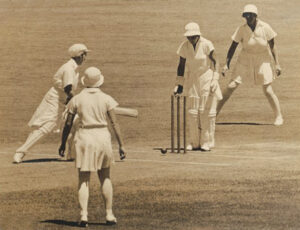
Photo: The 2nd Women’s Test match between Australia and England at Sydney in 1935.
Despite success, tours were difficult because of the cost. In 1958 the International Women’s Cricket Council (IWCC) was formed to oversee the touring schedule. The first ever IWCC meeting took place in Melbourne in February 1958 with women from England, Australia, New Zealand, South Africa and the Netherlands could attend. England visited Australia and New Zealand in 1948-49, 1957-58 and 1968-69.
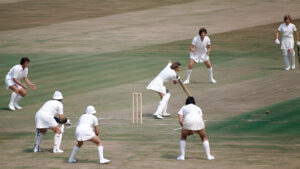
Photo: Llanelli-born Lynne, batting, who played for England from 1966 to 1979.
By the 1970s, women cricketers had formed associations in India and West Indies. For England, it took five years for English skipper Racheal Heyhoe-Flint, to convince the authorities to host a women’s international, with a threat to bring the case to the Equal Opportunities Commission of United Kingdom. The England captain’s efforts, coupled by their victory in the first World Cup in 1973, earned them an opportunity to play at the Lords iconic venue. They played at Lord’s in 1976, England vs. Australia women’s cricket test series (29 May – 8 August 1976) that was the Women’s Ashes, which England were defending.
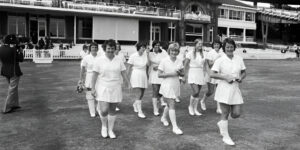
The series was drawn 0–0, meaning that England retained the Ashes. England won the three-match ODI series 2–1. The second ODI, won by England, was the first women’s cricket match ever played at Lord’s. Rachael Heyhoe-Flint had a superlative averages of 45.54 in Tests and 58.45 in ODIs and was a successful captain, but her true contribution possibly lay in the fact that she was almost single-handedly responsible for the rise of women’s cricket from a nondescript entity to the global concept that it is today.
Test result: 3-match series drawn 0–0
ODI result: England won the 3-match series 2–1.
England’s made their first tour of India in 1978 for the second World Cup, while West Indies first visited England in 1979.
Let’s look at India.
Mahendra Kumar Sharma, of the Uttar Pradesh Cricket Association (UPCA), convened a meeting in Lucknow that was attended by women representatives from Delhi, Maharashtra, Bengal, and other states, where the WCAI was formally established, under the Societies Act in Lucknow in 1973, under the presidency of Begum Hamida Habibullah. The first women’s cricket club, The Albees, was founded in Mumbai in 1969 by Aloo Bamjee. In 1973 Sharma, the WCAI’s first secretary organised the first women’s inter-state national competition in 1973, the significant step in promoting women’s cricket across India. Thus Mahendra Kumar Sharma is credited as the main founder of organised women’s cricket in India. For a long time, India’s women’s cricket headquarter was at Lucknow, hosting the first National Women’s Cricket Championship in 1973-74, and India found the first stars of Indian women’s cricket, including Diana Edulji, Shanta Rangaswamy, and Anjum Chopra.
India’s International Recognition & Achievements:
WCAI became a member of the International Women’s Cricket Council (IWCC) in 1973.
The first bilateral women’s cricket series was played in India in 1975 when the Australia U-25 team toured India to play a three-match Test series. Pune, Delhi, and Calcutta were the three venues. Interestingly, India had three captains for the three Tests – Ujwala Nikam, Sudha Shah, and Sreerupa Bose.
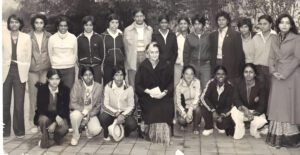
Photo: From the Archives: 1976 Indian Women’s cricket team with Indira Gandhi.
The team was: Diana Edulji, Shanta Rangaswamy, Anjali Pendharkar, Sandra Bregenza, Vrunda Bhagat, Sandhya Relekar, Mangala Babar, Manju Sharma, Shubhangi Kulkarni, Renuka, Shashi Gupta, Rekha Gadre-Godbole, Sujata Sridhar, Nilima Joglekar (Barve), Fowzieh Yaqabian, Sudha Shah, Rajeshwari Dholakia Antani.
After the Australia series, India played New Zealand, England, and West Indies, at home as well as away. The New Zealand, Australian, and England players played in skirts while the Indian and West Indians played in trousers.
The first international tour for the team took place in 1976 against the West Indies, and the ODI debut at the 1978 World Cup when India was the host country. Indian women’s cricket received government recognition in 1978.
Unfortunately, India had a disappointing outing in the 1978 World Cup as they lost all the three matches. The team led by Diana Edulji played its first ODI against England on January 1, 1978, at the Eden Gardens in Calcutta. In the same year, the WCAI received the International Women’s Cricket Council (IWCC) Government recognition in 1978.
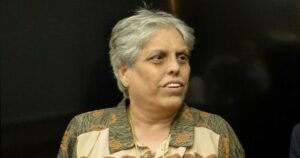
Indian Railways minister Kamalapati Tripathi attended the third Test of that West Indies series, at Delhi. His daughter-in-law Chandra Tripathi was then the WCAI president. Edulji walked up to him during the match with a simple request: her father was set to retire that same year, and she wanted a job with Railways. Edulji thus became the first female cricketer to be employed by Indian Railways in their sports quota. Then she did not have to worry about her livelihood anymore. She could solely focus on playing cricket, but she also went all out to ensure that her team mates, also earned the same privilege as well.
India won their first-ever ODI series in the Centenary Celebration of New Zealand Cricket in 1995. Shanta Rangaswamy, Diana Edulji, Sudha Shah, and Sandhya Agarwal gave significant contributions to this game. All the four players were awarded the Arjuna Award.
Between 1994 and 2005, India won six out of eight bilateral ODI series and a triangular tournament in New Zealand, which also featured Australia; and reached the World Cup final for the first time. From not winning a single match in the 1978 World Cup to reaching the finals in 2005 and 2017 was a huge change made by the Indian Women’s Cricket team. On the other side, India won their first-ever ODI series in the Centenary Celebration of New Zealand Cricket in 1995. Thus it took 17 long years for the team to make its mark in the ODI cricket.
Shanta was the first Indian woman cricketer to score a century in international cricket while Sandhya Agarwal made a world record by scoring 190 runs in an innings in a Test match in England in 1986. Apart from these, Neetu David’s 8-53 against England in 1995-96 was the record bowling effort in a Test match innings. Since we are talking about the history of Indian women’s cricket, we have just highlighted the pioneers of the game here.
In 2006, when BCCI merged women’s cricket into itself, the headquarters moved to Mumbai, and since then, BCCI has managed and run women’s cricket, giving it a significant boost.
The Indian Railways’ contribution to the growth of women’s cricket has been immense. Since 1970, the Railway was offering jobs and financial support to women players, at a time when the sport was struggling for funds. Railways provided a stability that helped the game survive and grow.
The Railways also gave the Indian women’s team AC coaches for travel and launched the first Inter-Railway Women’s Cricket Tournament. The organisation recruited top talent from across the country and provided structured training, playing a pivotal role in shaping generations of women cricketers. However, the Railway men’s team had been playing in the Ranji Trophy since 1958–59, but no such opportunity for the women’s team. That had to wait until 1984, when a group of female cricketers reached out to Railways minister Madhavrao Scindia, who commissioned a triangular intra-Railways tournament with the Western, Southern and Eastern sectors of the organisation. This served as a trial for the first-ever Railways Women team.
With Air India’s arrival in 1991, they too began to recruit cricketers to build their team, and challenged with competition to Railways, and not just on the field. The two beat names in Indian cricket: while Railways had Mithali Raj on their payroll, Air India got Jhulan Goswami.
Let’s cheer them up too because they are also the ones who made our country proud.
The Idea of Women’s World Cup.
English businessman Jack Hayward and cricketer Rachael Heyhoe Flint met at their home city, Wolverhampton. In 1971, Hayward and Heyhoe Flint stayed up all evening brainstorming a tournament that the latter would skipper England to victory two years later. Thus the idea came in place to host the Women’s One Day International (ODI), and the inaugural edition of the ICC Women’s ODI Cricket World Cup in 1973 marked the first time a worldwide tournament of its nature, with the men’s tournament following two years later. The event was the result of the vision of Rachael Heyhoe Flint and a £40,000 funding from businessman Sir Jack Hayward, both from Wolverhampton (the latter went on to own football club Wolves).
“We didn’t get given any medals for winning the World Cup, although we were introduced to Princess Anne,” recalls Lynne of that historic day at Edgbaston.
The Women’s ODI Cricket World Cup 1973 was contested by seven teams including a Young England side. The format was different to what we see today, with teams battling for 60 overs and a league table deciding the winners instead of a knock-out competition. However, the final round-robin match saw the top two square off as England took on Australia in a repeat of the first-ever international women’s game. Enid Bakewell hit 118 and Heyhoe Flint compiled a half-century as England won by 92 runs to seal the title by three points from their rivals.
Then India hosted and made their debut in the 1978 tournament, and they were joined by Australia, England and New Zealand. The final match was again a de facto final, but this time Australia triumphed over the holders as tens of thousands of Indian cricket fans flocked to the Lal Bahadur Shastri Stadium in Hyderabad to watch.
In 2005, after the 8th Women’s World Cup, the International Women’s Cricket Council was officially integrated under the umbrella of the International Cricket Council (ICC), and an ICC Women’s Cricket Committee was formed to consider all matters relating to women’s cricket.
In 2018, MCC acquired the archive of the Women’s Cricket Association.
 For the Sake of Records:
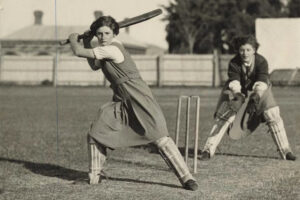
The highest total is Australia’s 569 for six declared against England Women in 1998, and the highest individual score is the 242 recorded by Kiran Baluch for Pakistan against West Indies at the National Stadium, Karachi in 2003/04. Five other women have scored double centuries. Neetu David of of India took eight wickets in an innings against England in 1995/56, she also took seven wickets on ten such occasions. Betty Wilson was the first player, male or female, to record a century and ten wickets in a Test match, against England at the MCG in 1958. In a remarkable match Australia were bowled out for 38 but gained a first innings lead of 3 runs in dismissing England for 35 in reply, with Wilson taking seven for seven. In 1985, Australia’s Under-21 National Women’s Cricket Championship was renamed the Betty Wilson Shield in her honour.
Women have beaten male teams to several milestones in one-day cricket. They were the first to play an international Twenty/20 match, England taking on New Zealand at Hove in 2004. Female wicket keepers were the first to record 6 dismissals in a one-day international, New Zealand’s Sarah Illingworth and India’s Venkatacher Kalpana both accounting for 6 batsman on the same day in the 1993 World Cup. Belinda Clark, the former Australian captain, is the only female player to have scored a double hundred in an ODI, recording an unbeaten 229 in the 1997 World Cup against Denmark. Pakistan’s Sajjida Shah is the youngest player to appear in international cricket, playing against Ireland four months after her 12th birthday. She also holds the record for the best bowling figures in a one-day international, taking 7 wickets for just 4 runs against Japan Women at the Sportpark Drieburg in Amsterdam in 2003. Fast bowler Cathryn Fitzpatrick of Australia took 180 wickets in her one-day international career.
References:
https://www.icc-cricket.com/media-releases/history-of-the-icc-womens-cricket-world-cup
https://www.lords.org/lords/news-stories/women-s-cricket-evolution
https://cricmash.com/feats/lords-hosts-the-first-womens-match
https://www.bbc.com/news/world-africa-29375679
*********



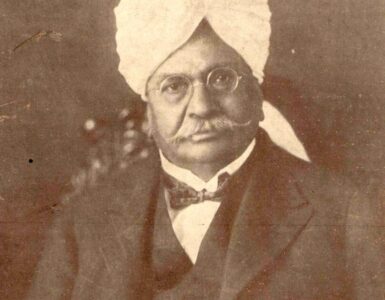


I have played a little bit of cricket during my school days, while the curious local boys and even aged neighbours used to look at me with surprising eyes. That was mid ’90s. But then, I had no opportunity at my college, so I had to bid goodbye cricket.
I am happy that now girls are coming up, some are emerging from rural India, also some of them are making global footprints.
I wish the women’s cricket should get the same household respect as the men’s cricket is.
Let’s hope.
Traditionally cricket was seen as a game for the men, and ruled by the men. We knew since childhood that cricket is a gentleman’s game. But some women decided to show up, and over a few decades they took over and did the triumph that none could have imagined. From mid 30s of the last century, they had to wait till 1973 for the first Women’s World Cup, and then it reached the corners of the world.
Now cricket is no more only for gentleman’s game; it broke the barrier.
Nice interesting to read. Thanks.
পড়লাম।
কিংববন্তী লেন হাটন বলছেন, “absurd, like a man trying to knit”, ক্রিকেটের জন্ম থেকেই এটি ছিল পুরুষদের খেলা, এবং নিয়ন্ত্রণের চাবিও ছিল পুরুষদের হাতে। আমরাও ছোটবেলা থেকেই জানি যে, ক্রিকেট ভদ্রলোকের খেলা। তাই আমার আর ক্রিকেট খেলা হলো না, রেডিওতে গাভাস্কার শুনেই সময় চলে গেলো। কিন্তু কয়েকজন উৎসাহী মহিলা, Rachael Heyhoe Flint, তাঁর নাম করতেই হয়, সিদ্ধান্ত নিলেন যে ক্রিকেট মহিলাদের জন্যও উন্মুক্ত করতে হবে। এবং তিন দশকের ব্যবধানে তাঁরা প্রথম সাফল্য অর্জন করলেন। ১৯৭৩ সালের প্রথম মহিলা বিশ্বকাপের পরেই মহিলাদের ক্রিকেট বিশ্বের বিভিন্ন দেশে জনপ্রিয়তা অর্জন করে।
লেখক অনেক তথ্য দিয়ে সুন্দরভাবে প্রতিবেদনটি তুলে ধরেছেন, অসংখ্য ধন্যবাদ।