
 Asim Deb
Compiled by: Asim Deb
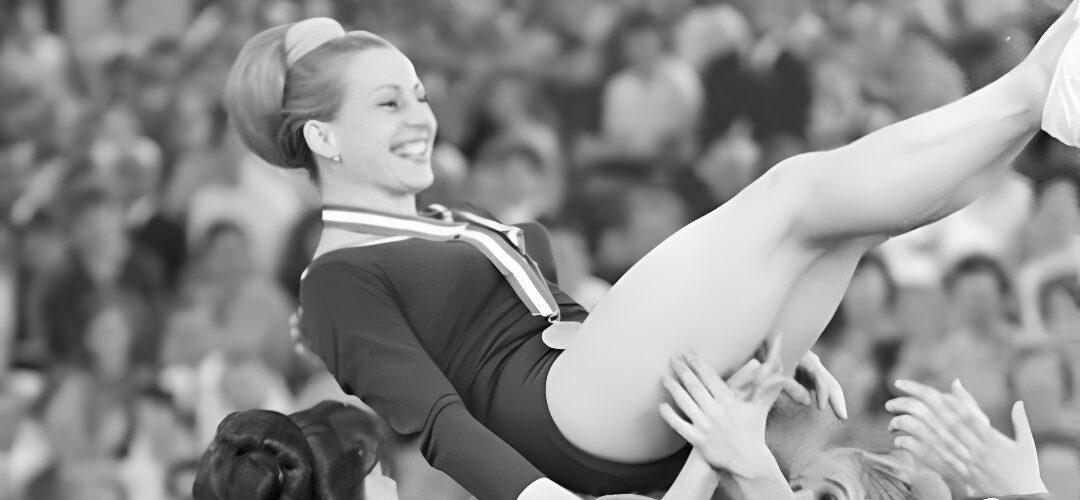
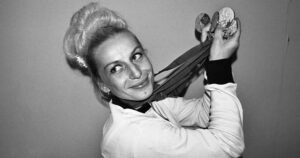
Between 1962 and 1968, this Czech girl dominated the world of gymnastics with 7 Olympic Gold, 4 Olympic Silver, 4 World Championships, 11 European Championships, and 22 International Golds in gymnastics. She was one of the two gymnasts (the other is Larisa Latynina), male or female, to have won an Olympic gold medal in each individual event. However, her career was curtailed after her support for greater freedom for her homeland against Soviet military aggression.
Věra Čáslavská is one of only three female gymnasts, along with Soviet Larisa Latynina and US Simone Bills, to win the all-around gold medal in two Olympics. In 1967, she was also the first gymnast to achieve two perfect scores of 10 at major competitions in the post-1952 era. She is the only gymnast who has swept all five European individual golds twice. She held the record of 7 individual gold medals among all female athletes (not only gymnasts) in the Olympic history as well until it was surpassed by swimmer Katie Ledecky in 2024 after 56 years.
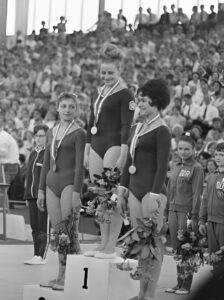
Even with all these credits, the Czech gymnast had to go on hiding before her practice sessions for 1968 Mexico Olympics, fearing political arrests for protest against Soviet invasion. Even after winning 34 international medals in gymnastics, the Czech government refused to offer her any job.
Vera Čáslavská (born May 3, 1942, Prague), was a Czech gymnast. Her father had a small grocery store that was seized by the Communist government in 1948. As a child, she took up figure skating and applied to the dance conservatory. After being turned down, she found work as a secretary and began studying artistic gymnastics. She began her athletic career as a figure skater, but at age 15 she turned to gymnastics, first appearing in international competition at the 1958 world championships at Moscow, where she won a silver medal in the team event. She then won the balance beam at the 1959 European Women’s Artistic Gymnastics Championships where she won gold on the vault and silver on the balance beam. Then at the 1960 Olympics in Rome, she won a silver medal in the team event. She finished a close second to the Soviet gymnast Larisa Latynina at the 1962 world championships. Čáslavská made her Olympic debut at the 1964 Games in Tokyo, where she took gold medals in the all-around, the balance beam, and the vault, and a silver in the team event. At the 1965 and 1967 European championships, she won every event she contested in the women’s gymnastics group. At the 1966 world championships, she contributed to the Czech team’s victory over the Soviets, winning the gold in the combined exercises.
In June 1968 Čáslavská signed the “Two Thousand Words”, a strong document of Ludvik Vaculík’s manifesto that called for democratic governance in Czechoslovakia. Fearing uprising, the Soviet tanks entered and invaded Prague in August that year, just two months before the Olympic Games. Čáslavská, facing possible arrest, fled to the mountain village of Šumperk, a countryside in Moravia where she maintained her training by lifting sacks of potatoes, swinging from tree branches and using a log for a balance beam. Under worldwide criticism, after three weeks, the government granted her permission to rejoin the Olympic team only a few weeks before the 1968 Olympic in Mexico.
“While the Soviet gymnasts were already in Mexico City, adjusting to the altitude and the climate, I was hanging from trees, practicing my floor exercise in the meadow in front of the cottage and building calluses on my hands by shoveling coal,” she told The Los Angeles Times in 1990. “Then I went to Mexico and won the gold medal.”
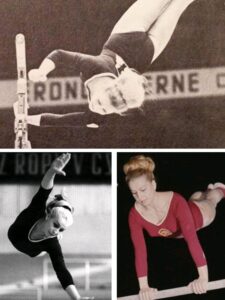
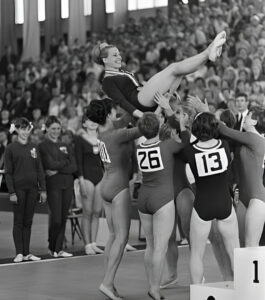
In 1968 Mexico Olympics, she won gold in the vault, the all-around, floor exercise and uneven bars and silver medals in the balance beam and the team competition. She had to share the gold medal in the floor exercise with Larisa Petrik of the Soviet Union. Soviet girl Larisa Petrik was originally second, but moved up by the Soviet judges at the last minute. She appeared to have won the gold medal on floor outright, the judging panel curiously upgraded the preliminary scores of Soviet Larisa Petrik, and declared a tie for the gold instead. In another very controversial judging decision that cost Čáslavská the gold on beam, instead awarding the title to Soviet rival Natalia Kuchinskaya. Clearly disheartened and angered by the politics that favored the USSR, she protested during both medal ceremonies by quietly turning her head down and turned away during the playing of Soviet national anthem. It was a silent protest, an act of defiance that put her career on ice. Sportscaster Jim McKay described the situation to US TV viewers: “Now the Soviet anthem. And again she has turned her head to the right and down, just as she did at the last ceremony. This does not appear to be an accident.”
During the Mexico Olympic event, Caslavska was an audience darling, where she performed her floor routine to “The Mexican Hat Dance.” Her achievements in winning four golds at Mexico put her in exalted company, alongside Biles, Agnes Keleti and Larisa Latynina for Hungary and the Soviet Union respectively in 1956 and Romania’s Ekaterina Szabo in 1984.
“After ascending the summit of Olympus, the journey downward did not exactly follow the well-trodden path,” she reflected later. “It consisted of rocks, gorges and a bottomless pit.”
On her return to Prague, she gave her four gold medals to the Czech leaders of the “Prague Spring”. Then, Čáslavská also fell out of favor with the Czech authorities and was initially refused employment for being an “unhealthy influence.” She was not allowed to take employment unless she stated she had not signed the manifesto. She refused. Retribution was swift. She was barred from travelling abroad and for many years denied any coaching post, bringing an end to her international career. She was forced into retirement and for many years was denied the right to travel, work and attend sporting events.
The same year, 1968, she was the runner-up to Jackie Kennedy in a poll of the world’s most popular women. A few months later, while in the United States to attend an Amateur Athletic Union ceremony honoring her as the top female athlete in the world for 1968, she told reporters, “We all tried harder to win in Mexico because it would turn the eyes of the world on our unfortunate country.”
After 1975, she was allowed to advise the coaches of the national gymnastics team but was not allowed to travel abroad to competitions.
In 1989, she was honoured with Pierre de Coubertin International Fair Play Trophy by UNESCO and was noted at the ceremony for her “exemplary dignity”. Then in 1991, she was inducted into the International Women’s Sports Hall of Fame. In 1998 she was inducted into the International Gymnastics Hall of Fame.
After the collapse of communist rule in 1989, Čáslavská served as an advisor to President Vaclav Havel on sports and social issues. When the union with Slovakia was dissolved in 1993, she was named President of the Czech Olympic Committee. She was also a member of the International Olympic Committee (1995–2001).
Čáslavská experienced many other hardships. But she never bemoaned her fate, she told Czech Radio a year before her death in 2016.
“It’s a waste of time. For instance, I could lament the fact that I was active at a time when we got a carnation for a great performance. Today sports people have all the advantages. But I don’t regret a thing. Things were as they were meant to be and it’s still like that. Crying over spilt milk doesn’t get you anywhere.”
Honours:
1968, best female athlete of the world declared by the United States Amateur Athletic Union.
1998, was inducted into International Gymnastics Hall of Fame
2010, was awarded the Order of the Rising Sun, 3rd rank.
2014, was presented a 17th-century Katana and a ceremonial kimono from the Japanese emperor.
2014, she was the joint recipient (with AP Journalist Iva Drapolova) of the Hanno R. Ellenbogen Citizenship Award, awarded annually by the Prague Society for International Cooperation and Global Panel Foundation, for outstanding civic courage.
References:
https://www.olympics.com/en/athletes/vera-caslavska
https://www.bbc.com/sport/gymnastics/37232022\
https://www.britannica.com/biography/Vera-Caslavska
https://english.radio.cz/vera-caslavskas-silent-protest-1968-olympics-recalled-8147797
The Telegraph, NY Times, Wikipedia.
https://www.youtube.com/watch?v=SyYMcLwKreo
*********




You have rightly pointed out.
She achieved two perfect 10s at the 1967 European Women’s Artistic Gymnastics Championships in Amsterdam, and completely swept the competition, taking home all five individual gold titles.
Later on Nadia did in 1976 Montreal.
To me, she is the greatest woman gymnast for ever, who earned all her medals when even her country was harassing her.
She was a fighter, on the floor, and also off the floor.
Beautifully sketched her sports life.
Thanks
I was in standard 6th in school when I heard / read her name for the first time, courtesy olympics. Being so little, I could know only about her medals, nothing beyond. Later in bits and pieces, I knew a little about her struggles.
Now, from this article, I could read about her struggled life and passion in the sports profession. She has created the example that it’s courage that makes you different from others.
It my pleasure to know so much more about champion darling Vera Caslavska from this article.
Thanks author.
A good tribute and biography of an exceptional women who deserves highest respects for both her courage and for the landmarks she could achieve. The script is also beautifully narrated and precise.
Vera Caslavsa was a brave interesting uncommon personality, a rare brand of herself who despite all sorts of government sponsored political oppressions, could remain determined in her mission, both in the games, and also supporting the nation.
I would share it with my friends.
My regards.
লেখাটি পড়ে ভালো লাগল।
এটি সোভিয়েত যুগের দমননীতির বিরুদ্ধে একটি সাহসী নারীর প্রতিবাদের জয়। প্রতিবাদী সম্প্রদায়ের আরেকটি গৌরবময় মাইলফলক; বিশেষ করে এমন এক সময়ে, যখন পুর্ব ইউরোপে মানুষের রাজনৈতিক অধিকার ছিল না, এমনকি খেলাধুলার ক্ষেত্রেও অনেক অবিচার করা হয়েছে।
ভেরা ক্যাসলাভস্কা একটি প্রতিষ্ঠান, কঠিন পরিস্থিতিতেও নিজের সাহস, একাগ্র ট্রেনিং, যোগ্যতা ও অবস্থান প্রতিষ্ঠায় অগ্রদূতদের মধ্যে অন্যতম স্বীকৃতি অর্জন করেছেন।
এই মহান এথলীটের প্রতি আমার আন্তরিক শ্রদ্ধা ও অভিবাদন।